
Best Sprouting Kits (2026): 5 Picks
Five sprouting kits: a full jar kit, two sets of lids for your own jars, stacked trays and a display jar.
As an Amazon Associate we earn from qualifying purchases. Some links are paid.
The best sprouting kit on this list is the ZestiGreens Jar Sprouts Growing Kit: two 32 oz glass jars with sprouting lids, a stainless steel stand with a drip tray, and blackout sleeves, with no seed in the box.
Top picks

First choice: jars, lids, a stand and dark sleeves in one box
1. ZestiGreens Jar Sprouts Growing Kit
Two 32 oz glass jars with sprouting lids, a stainless steel stand with a drip tray, and blackout sleeves, sold without seed.
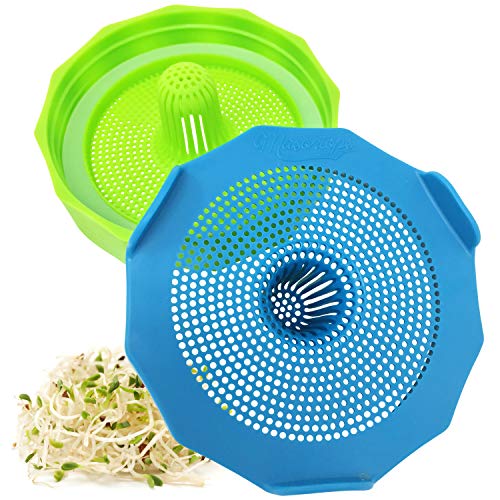
Budget pick for wide-mouth jars you already own
2. Masontops Bean Screen Sprouting Lids
Two plastic screen lids whose pegs hold a wide-mouth jar upside down to drain, with an inverted spout for air and rinsing.

Stainless steel lids for wide-mouth jars
3. Mason Jar Lifestyle Curved Sprouting Lids
Three curved one-piece lids of 316 stainless steel mesh that hold the sprouts off the counter while the jar drains.
| Pick | What's in the box | Best for | Price class | Where to buy |
|---|---|---|---|---|
| 1. ZestiGreens Jar Sprouts Growing Kit | 2 glass jars, lids, stand, drip tray, dark sleeves | A first setup, seed aside | budget pick | Check price on Amazon |
| 2. Masontops Bean Screen Sprouting Lids | 2 plastic lids with drain pegs | Your own wide-mouth jars | budget pick | Check price on Amazon |
| 3. Mason Jar Lifestyle Curved Sprouting Lids | 3 curved stainless steel lids | Wide-mouth jars, steel screens | budget pick | Check price on Amazon |
| 4. ZestiGreens Easy Rinsing Sprouting Kit | 4 stacking tiers, drain spout | Trays watered from the top | budget pick | Check price on Amazon |
| 5. ZestiGreens Showpiece Sprouter | 1 glass jar, steel mesh lid, bamboo stand, drip tray | A jar left out on the counter | premium | Check price on Amazon |


Sources: ZestiGreens, Masontops, Mason Jar Lifestyle, Selecting and Serving Produce Safely and 5 more. See the sources we used. How we source our guides

On this page (11)
A sprouting kit holds seed where you can rinse it, then lets the water run off so the seed stays damp without sitting in a puddle. The five kits here do that in three ways: a complete jar kit, screen lids that turn a wide-mouth canning jar into a sprouter, and a stack of trays that drain from the top down. We kept to hardware, so none of the five comes packed with seed.
How we chose these: every product figure below comes from the product's own maker page; we measured none of them. Before a first batch, read the food safety section: no kit takes the risk out of raw sprouts.
Start here: pick the sprouting kit by what you already own
- No gear yet, and you want jars, lids, a stand and a dark cover in one box: ZestiGreens Jar Sprouts Growing Kit (pick 1).
- Wide-mouth canning jars in the cupboard, and plastic lids will do: Masontops Bean Screen Sprouting Lids (pick 2), two lids with pegs that hold the jar upside down.
- Wide-mouth jars, but you would rather have steel screens: Mason Jar Lifestyle Curved Sprouting Lids (pick 3), three lids to a box.
- Trays you water from the top, with no jar to tip: ZestiGreens Easy Rinsing Sprouting Kit (pick 4), four stacking tiers and a drain spout.
- One jar made to stay out on the counter: ZestiGreens Showpiece Sprouter (pick 5), a glass jar on a bamboo stand.
On the makers' own list prices, four of the five are budget picks and the Showpiece Sprouter is premium.
Five sprouting kits: jars, lids and trays
Each card's parts, materials and fit come from its maker; the table after the cards puts the five side by side.
1. ZestiGreens Jar Sprouts Growing Kit: first choice, the jar method in one box
Best for: A first sprouting setup with only seed left to buy Price class: budget pick
Two 32 oz glass jars with sprouting lids, a stainless steel stand with a drip tray, blackout sleeves, a lid for regrowing green onions and illustrated instructions. Its maker sells this kit without seed. The routine on its page is short: soak the seed in the jar for up to 8 hours, rinse and drain twice a day, and harvest in 4 to 6 days, depending on the seed.
Why it made the list: No other pick here arrives with jars, sprouting lids, a stand and a cover for the dark, so seed is the one thing left to buy. A wide-mouth jar under a sprouting lid is a popular way to grow sprouts, because that kind of lid lets the seed drain properly between waterings. Sprouts also need a dark spot while they grow, and the sleeves stand in for the cabinet or the towel that would otherwise do that job.
Before you order: Nothing on its maker's page names the screens' material or mesh size, says whether the jars have wide or regular mouths, or says whether any part can go in the dishwasher; its care line is to clean and dry the reusable parts between crops. No warranty is stated on its product page.
2. Masontops Bean Screen Sprouting Lids: budget pick for jars you already own
Best for: Turning wide-mouth canning jars into sprouters Price class: budget pick
- Lids: 2, BPA-free plastic
Two plastic screen lids, one blue and one green, that screw onto wide-mouth canning jars such as Ball, Bernardin and Kerr. Each lid measures 3.6 inches across and 1.1 inches high. An inverted spout lets air in and is shaped for rinsing without splashes, faceted sides keep the jar from rolling, and pegs let the jar be left upside down to drain.
Why it made the list: Most batches that go wrong come down to airflow and drainage, and these lids handle both on a jar you already have: the spout for air, and pegs that keep the jar draining mouth-down. Its maker lists the lids as dishwasher safe and made of BPA-free and phthalate-free plastic.
Before you order: The box holds the two lids and no jar, and they fit wide-mouth jars only, a mouth 3.38 inches (8.6 cm) across the outside. Its maker asks you to wash them before each use and between uses. Its product page states no warranty terms.
3. Mason Jar Lifestyle Curved Sprouting Lids: stainless screens for wide-mouth jars
Best for: A steel screen that can go in the dishwasher or boiling water Price class: budget pick
- Lids: 3, 316 stainless steel mesh
Three one-piece lids of stainless steel mesh, sized for jars with a 3-inch internal diameter, which is the wide-mouth size; no jar comes with them. The lid is curved, so with the jar tipped mouth-down to drain, the sprouts are held off the counter, and its maker says the shape also gives better airflow. The tightly woven screen is meant for all the common sprouting seeds.
Why it made the list: Pick 2's job, done in metal. Its maker says the heavy duty mesh will not break or rust, uses 316 stainless steel for the wide-mouth lids, and says they can go in the dishwasher, boiling water, the oven and the freezer. The maker's store carries a 6-month warranty.
Before you order: These are the wide-mouth lids only; the regular-mouth version is a separate item, a mesh insert and band sold one at a time. Its maker gives no mesh size.
4. ZestiGreens Easy Rinsing Sprouting Kit: for trays instead of jars
Best for: Watering from the top, with no jar to tip Price class: budget pick
Four stacking tiers and a drain spout: a tablespoon of seed in each tray, watered from the top twice a day.
Stackable growing trays, linked here in the 4-tier size, with a drain spout. You spread a tablespoon of seed in each tray and water from the top twice a day; the water runs down to the bottom tray, or out into the sink. Its maker gives a harvest in 4 to 6 days, depending on the seed.
Why it made the list: Trays take the tipping out of sprouting: its maker's pitch is sprouting with no jar to shake or tilt, and each tier takes its own tablespoon of seed. Its maker describes improved drainage, higher side walls and interchangeable trays in a BPA-free, food-grade design, and backs the kit with a lifetime replacement warranty.
Before you order: No tray size, capacity per tray or tray material beyond BPA-free and food-grade is given by its maker. Its parts list names no cover for the dark, so set the stack in a dark cupboard or put a towel over it. Follow the kit's and the seed's own directions on soaking, rinsing and when to harvest, drain the trays thoroughly between rinses, and clean and dry the parts between crops.
5. ZestiGreens Showpiece Sprouter: premium, one jar made for the counter
Best for: A sprouter that stays out on a bamboo stand Price class: premium
A thick hexagonal glass jar with a screw-on lid of 316 stainless steel mesh, a bamboo stand, and a drip tray of clear polycarbonate. The jar rests mouth-down in a white-lined bamboo ring, tilted over the oval tray. Its opening is 9.6 cm wide.
Why it made the list: The shape is built around draining. Straight walls keep water from pooling around a narrow neck, the stand's angle helps drainage and airflow, and the hexagonal glass helps the seeds spread out. The wide opening makes the jar easier to clean, and its maker gives a one-year guarantee with support based in the U.S.
Before you order: It is a single jar, and its maker gives neither the jar's capacity nor whether any part can go in the dishwasher.
How we chose these
We looked for sprouting hardware whose maker publishes, on its own site, what comes in the box and how the parts drain, and we checked every pick against that page. Every link points at the product that maker sells, tied to the maker's page by a barcode, a model number or the maker's own list of parts and sizes. We left out kits packed with seed, which are seed products, and the seed is the part that needs its own choice (see the food safety section). Kits we could not tie to a maker page of their own were left out too. That left five kits from three makers; one maker has three picks, one for each of its ways to sprout: a jar kit, trays and a single display jar.
The jar kit leads the list: it is the only pick with everything but seed in the box. The two lid sets come next: strictly, a glass jar with a cover that lets water out is all the method needs, and these lids are the budget way to give a jar a proper screen. The trays come fourth, for growing in a stack instead of a jar, and the Showpiece Sprouter closes the list as the premium pick. We did not sprout seed in these kits ourselves.
Our editorial policy says how we find, check and number the picks in every buying guide.
How the five kits compare
| Pick | What's in the box (maker's list) | Jar (maker's spec) | Screen (maker's spec) | Fits (maker's spec) | How it drains (maker's description) | Cleaning (maker's care line) | Warranty (maker's terms) |
|---|---|---|---|---|---|---|---|
| 1. ZestiGreens Jar Sprouts Growing Kit | Two glass jars, sprouting lids, a regrower lid for green onions, steel stand, drip tray, blackout sleeves, instructions | Two, glass, 32 oz each | Not given | Its own jars | Stand and drip tray | Clean and dry the reusable parts between crops | Not given |
| 2. Masontops Bean Screen Sprouting Lids | 2 lids, blue and green | Not included | BPA-free, phthalate-free plastic | Wide-mouth jars, 3.38 in outer mouth | Pegs hold the jar upside down; inverted spout | Dishwasher safe; wash before each use | Not given |
| 3. Mason Jar Lifestyle Curved Sprouting Lids | 3 one-piece lids | Not included | 316 stainless steel mesh | Jars with a 3 in internal diameter | Curved lid keeps sprouts off the counter with the jar tipped | Dishwasher, boiling water, oven and freezer | 6 months |
| 4. ZestiGreens Easy Rinsing Sprouting Kit | Stackable growing trays (4 tiers as linked), drain spout | None: trays | Not given; BPA-free, food-grade | Not a lid | Water from the top drains to the bottom tray or the sink | Clean and dry the reusable parts between crops | Lifetime replacement |
| 5. ZestiGreens Showpiece Sprouter | Hexagonal glass jar, screw-on lid, bamboo stand, polycarbonate drip tray | One, thick glass; capacity not given | 316 stainless steel mesh | Its own jar, 9.6 cm opening | Jar rests mouth-down, tilted over the tray | Not given; the wide opening eases cleaning | One year |
Raw sprouts and food safety: what a kit can and cannot do
The risk with sprouts starts in the seed, and no jar, lid or tray on this list removes it. Seeds and beans sprout in warmth and humidity, the same conditions that bacteria thrive in, Salmonella, Listeria and E. coli among them. Even a few harmful bacteria carried by a seed can reach high levels as it sprouts, under sanitary conditions in a home kitchen too. Growing your own probably does not lower the risk, because contaminated seed looks to be where it comes from; a home grower faces the same risk as a commercial one.
From 1996 through 2020, sprouts were linked to 52 reported outbreaks of foodborne illness and more than 2,700 cases, and in many of those outbreaks the seed was the likely source. Alfalfa and clover turn up most often in sprout outbreaks, yet any raw sprout may carry the risk, since all of them grow in much the same conditions.
The FDA's advice is that children, pregnant women, older adults and anyone whose immune system is weakened avoid "raw or lightly cooked sprouts of any kind". Cooking sprouts thoroughly kills the harmful bacteria and significantly reduces the risk of illness.
That makes the seed the purchase to think hardest about. Buy seed sold expressly for sprouting, since garden seed meant for planting may carry a fungicide or insecticide treatment. Seed does not have to be labeled as pathogen free, so ask the seller whether it is certified.
What a jar, a lid and a tray each do
The routine is the same in every kit: rinse the seed, drain it well, and keep it dark until it is ready. Rinse the seed and drain it two to four times a day. Most batches are ready in three to six days, though the time may vary with the seed and the length you want. Between rinses you want damp seed, not seed standing in water: seed left standing in water will ferment and spoil.
The kits differ in how they drain. A screen lid lets the rinse water pour off while the seed stays in, and the jar can then be left upside down to keep draining: that is what the pegs on pick 2, the curve of pick 3 and the tilted stand of pick 5 are for. The trays in pick 4 drain from the top tray down through the stack. Most failed batches come down to poor airflow or poor drainage, and a small change to the setup usually fixes it.
Keep the sprouts in the dark while they grow: in a cupboard, under a towel, or in blackout sleeves like pick 1's, at room temperature. A few hours of sun in a window at the very end can green them up; much longer and they turn tough and bitter.
Check the jar mouth before you buy lids
Canning jars come in many shapes and sizes, but the mouth is one of two: wide, 3.38 inches (8.6 cm) across the outside, or regular, 2.75 inches (7 cm). Picks 2 and 3, as linked here, fit wide-mouth jars only: pick 2 names Ball, Bernardin and Kerr jars, and pick 3 is sized for a 3-inch internal diameter. Measure a jar you mean to use before you order.
Cleaning a sprouting kit between batches
Start every batch with clean parts: wash the jar, lid or trays in hot, soapy water first. Each maker says something about cleaning: the jar kit and the trays call for the reusable parts to be cleaned and dried between crops, the Masontops lids go in the dishwasher and should be washed before each use, the steel lids can go in the dishwasher or boiling water, and the Showpiece's wide opening makes its jar easier to clean.
To sanitize glass jars, mix 3/4 cup of plain, unscented bleach into a gallon of water and leave the jars in it for 5 minutes or more, then rinse them in clean water and let them dry. If mold or slime shows up in a batch, throw out everything in the jar, scrub the jar in hot water and detergent, and sanitize it before you start again. Discard any sprouts with black spots, brown patches or a slimy feel, and once the rest are grown, refrigerate them at 40 F or below.
Related guides
- How to grow sprouts in a jar, the step-by-step method, with soak times and days for each seed.
- Growing microgreens, seedlings sown in a shallow tray of mix and cut young.
- Indoor herb gardens, countertop units with their own lamp, for herbs in winter.
- Mushroom grow kits, for another harvest grown on the kitchen counter.
Frequently asked questions
Which sprouting kit is the first choice?
The ZestiGreens Jar Sprouts Growing Kit: two 32 oz glass jars with sprouting lids, a stainless steel stand and drip tray, and blackout sleeves, sold without seed. With wide-mouth canning jars already at home, the lids in pick 2 or pick 3 turn them into sprouters.
Do I need a sprouting kit to grow sprouts?
No. A glass jar covered with cheesecloth, held on by a screw-on ring, will do. A kit handles the parts of the routine that a bare jar leaves to you: a screen lid or tray lets water out without losing seed, pegs or a stand keep the jar draining, and a sleeve keeps it dark.
Are homegrown sprouts safer than store-bought ones?
Probably not. Contaminated seed appears to be where the risk comes from, and harmful bacteria on it can still grow while it sprouts in a clean kitchen, so home sprouts face the same risk as commercial ones. Children, pregnant women, older adults and anyone whose immune system is weakened should avoid raw sprouts, and cooking sprouts thoroughly significantly reduces the risk.
Will sprouting lids fit my jars?
Picks 2 and 3, as linked, fit wide-mouth canning jars only. A wide mouth measures 3.38 inches (8.6 cm) across the outside and a regular mouth 2.75 inches (7 cm); pick 3 is sized for a 3-inch internal diameter. Measure your jar before you order.
How often do you rinse sprouts in a kit?
At least twice a day, and up to four times, draining fully each time so the seed stays damp without standing in water. Most batches are ready in three to six days. The trays in pick 4 are watered from the top twice a day, and the water drains down through the stack.
Sources
- "ZestiGreens: Jar Sprouts Growing Kit"
- "ZestiGreens: Easy Rinsing Sprouting Kit"
- "ZestiGreens: The Showpiece Sprouter"
- "Masontops: Bean Screen Sprouting Lids"
- "Mason Jar Lifestyle: Curved Rust Proof Sprouting Lid and Band for Mason Jars"
- "Selecting and Serving Produce Safely" (U.S. Food and Drug Administration)
- "FDA Issues Final Guidance for Seeds Used for Sprouting" (U.S. Food and Drug Administration)
- "What You Should Know About Sprouts" (Penn State Extension)
- "University of Vermont Extension: growing sprouts at home"
- "Seed and Bean Sprouts" (University of Connecticut, Food Safety)
- "Growing Edible Sprouts At Home" (Nebraska Extension in Lancaster County)