
Carrot Plant: How to Grow Carrots From Seed to Harvest
Sow carrot seed directly once the soil reaches at least 45 F, keep it damp for two to three weeks, thin to 1 to 4 inches, and harvest about 65 to 75 days after sowing. Sow again 10 to 12 weeks before the first fall frost.
Sources: University of Maryland Extension, Illinois Extension, Clemson Cooperative Extension, University of Minnesota Extension and 1 more. See the sources we used. How we source our guides

On this page
To grow carrots, sow the seed straight into loose, stone-free soil once it reaches at least 45 F, cover it with 1/4 to 1/2 inch of fine soil, and keep that thin layer damp until the seedlings show, which can take two to three weeks. Thin the row so the roots stand 1 to 4 inches apart, water evenly, and pull the roots when they reach the size you want, usually 65 to 75 days after sowing. A second sowing 10 to 12 weeks before your first fall frost gives the sweetest carrots of the year.
The carrot plant is a cool-season root, rated semi-hardy in one guide and hardy in another: the tops take a light frost, and the roots handle cold better than the leaves do. It prefers average temperatures of 60 to 65 F, which is why spring and fall are the two seasons that work. This guide follows four land-grant extension pages, shows where they disagree, and turns their timing into dates for four real weather stations.
| Sun | Full sun, at least 6 hours a day; 8 to 10 preferred |
|---|---|
| How to start | Sow seed directly; never start in pots |
| Soil temperature | At least 45 F to sow; 55 to 75 F ideal for germination |
| Sowing depth | 1/4 to 1/2 inch in spring |
| Spacing | Thin to 1 to 4 inches; rows 12 to 18 inches apart |
| Days to come up | Several days, up to 2 or 3 weeks |
| Days to maturity | About 65 to 75 from seed (60 to 70 in one guide); finger types usually 50 to 60 |
| Frost tolerance | Semi-hardy or hardy, by guide: tops take a light frost, roots take more cold |
| Fall sowing | 10 to 12 weeks before the first fall frost |
| Water | About 1 inch a week |
When to plant carrots
Spring timing is set by soil, not by a calendar. One guide waits for soil of at least 45 F; another says carrots usually go in with the other frost-tolerant crops as soon as the ground can be worked, a little earlier on sandy ground. In Minnesota, carrot planting starts April 15. None of the guides gives a fixed number of weeks before the last spring frost, so the table below does not invent one. Check the soil with a thermometer at seed depth instead.
Fall timing does come with a number: sow a fall crop 10 to 12 weeks before the first fall frost. The table applies that rule to the median first 32 F date at four weather stations (1991-2020 climate normals), so you can see how much the window moves from Minneapolis to Atlanta. Use the station nearest you, or look up your own station's normals; a hardiness zone is not a frost date.
| Station (1991-2020 normals) | Median last spring 32 F | Median first fall 32 F | Fall sowing (10 to 12 weeks before first frost) |
|---|---|---|---|
| Minneapolis-St. Paul, MN | Apr 23 | Oct 18 | Jul 26 to Aug 9 |
| Chicago O'Hare, IL | Apr 16 | Oct 28 | Aug 5 to Aug 19 |
| Washington Reagan, VA | Mar 24 | Nov 18 | Aug 26 to Sep 9 |
| Atlanta Hartsfield, GA | Mar 15 | Nov 20 | Aug 28 to Sep 11 |
Station dates come from the 1991-2020 climate normals: by each date, the season's last spring 32 F night (or first fall one) has a 50 percent chance of having happened. Spring sowing follows soil temperature (at least 45 F) or workable ground, not a count of weeks, so the table has no spring column.
A median date means a frost after it is still possible in about half of all years, so the late edge of each fall window is the risky edge. Sow toward the early end if your summers stay hot into September, because carrot seed will not germinate in soil above 95 F, and roots maturing in high heat tend to turn strong-flavored and coarse.
Sowing carrot seed and getting it up
Carrots are always direct sown. Never start them in pots: the taproot begins growing early, and transplanting bends and damages it. Work the bed first (next section), rake it smooth, and then decide how you will handle the seed, which is small and hard to space.
- Depth. In spring, the seed goes 1/4 to 1/2 inch down. Later sowings may go down 1/2 to 3/4 inch, once the surface is drier and warmer.
- Rate. Guides differ here. One caps it at 2 or 3 seeds to the inch; another aims for about a quarter inch between seeds, with rows set 12 to 18 inches apart, and suggests mixing the seed with dry sand so it spreads evenly.
- Prepared seed. Pelleted seed (each seed coated in clay) and seed tape both make even spacing easier. If you can place seed every 2 to 4 inches this way, you can skip most of the thinning.
- A row marker. Drop a few radish seeds in the row. Radishes come up in days and show you where the slow carrots are; our guide on how to grow radishes covers that crop in full.
The hard part is the wait. Germination can take from several days to as long as three weeks, and the seedlings may not come up evenly. During that time the top quarter inch has to stay damp, and a crust is the enemy. A heavy rain or a hard watering can seal the surface so tightly that no seedlings may emerge at all.
Two fixes help. One guide skips soil as the cover: it sprinkles the seed and covers it with just 1/8 inch of vermiculite, sawdust or bagged potting soil, then waters, so the cover stays loose and moist. Clear plastic film over the row warms the soil and holds moisture; remove it the moment seedlings appear. In dry spells, water lightly every day until the plants are established, and mist a crusted surface, which may help the seedlings break through.
What to plant with carrots
Radishes are the standard partner: sow them alongside the carrots, then lift the radishes out before they crowd the slower roots. Carrots planted near tomatoes get shade from the heat, and mixing taproots with shallow-rooted crops such as onions and lettuce makes the roots less likely to get in each other's way. Our companion planting chart rates the evidence for each pair.
| Range, or the split between guides | |
|---|---|
| Sowing depth | 1/4 to 1/2 in of soil in spring, 1/2 to 3/4 in for later sowings; or 1/8 in of vermiculite, sawdust or potting soil |
| Seed rate | No more than 2 or 3 seeds per inch, or about 1/4 in between seeds; wide rows; prepared seed every 2 to 4 in |
| Row spacing | 12 to 18 in |
| Thin to | 1 to 4 in, 2 to 3 in or about 2 to 4 in (1 to 2 in in wide rows); by type, from 3 per inch for finger carrots to 1 per 1 to 2 in for full-size ones |
| Soil temperature | At least 45 F to sow; 55 to 75 F ideal for germination; none above 95 F |
| Days to come up | Several days to 3 weeks |
| Days to harvest | About 65 to 75; about 60 to 70 for non-finger types; finger types usually 50 to 60; or any usable size |
| Storage | 32 to 33 F and high humidity (90 to 95% RH), 4 to 6 months (up to 4 to 5 in one guide); a root cellar; a fridge above 32 F lets roots sprout |
The guides do not agree to the inch, and they do not need to. The depth range is narrow, every guide wants the seed shallow and damp, and the bigger gaps (thinning distance and days to harvest) come from the type of carrot you grow and how big you want it.
Thinning
Thinning is where most carrot crops are won or lost. A row of lush tops and small roots usually means the plants are crowded. Roots that grow into each other also twist and wrap; twisting comes from seed sown too thickly and not thinned enough.
The guides give different spacings, and the difference tracks the root you are growing:
- One: thin to 1 to 4 inches when the plants are about 2 inches tall, and in wide rows to 1 to 2 inches.
- Another: thin to 2 to 3 inches once seedlings stand 1 to 2 inches high.
- A third: thin to about 2 to 4 inches once the biggest seedlings reach 3 to 4 inches, wider for varieties that grow large.
- A fourth, by type: as many as 3 seedlings to the inch for finger carrots, 1 or 2 to the inch for carrots pulled young, and one plant per 1 to 2 inches for full-size Danvers and Chantenay types.
A technique worth copying: cut the extra seedlings at the soil line with scissors instead of pulling them, so the roots left behind are not disturbed (one guide simply pulls them). Thin in two passes if you sowed thickly, and eat the second round of thinnings; the small roots are good in salads, greens and all.
Beds for straight roots
A carrot root takes the shape of the soil it grows through. Carrots prefer a loamy or sandy soil free of stones and clods, and a light sandy loam grows well-shaped roots. Guides differ on clay: one says roots in heavy clay grow poorly and may fork, another that clay is fine if it drains well and is not compacted. Prepare the ground 8 to 9 inches deep and break up clumps, because a clod or stone deflects the root tip.
Three practical ways to get there:
- Raised beds. Carrots do well in raised beds, since you control the depth and texture of the soil.
- Match the type to the soil. Short types forgive heavy ground; see the varieties section below.
- Hold back on fresh organic matter. Work in well-rotted manure or compost during spring or fall, but avoid excess raw debris such as woodchips just before sowing. Too much nitrogen can also push leaf growth at the expense of the root.
Soil test first if you can. Guides put the pH target at 6.0 to 6.5 or at 6 to 7; a soil test tells you whether you need lime at all and how much fertilizer the bed really lacks, which matters for a crop that can run to leaf when overfed.
How much water carrots need
Water steadily once the plants are up: an inch a week from rainfall or irrigation, applied deeply once a week on heavy soil and twice a week on sandy soil. Dry roots may come out bitter, tough and misshapen. Mulch 3 to 4 inches deep with weed-free straw or clean grass clippings once the seedlings are a few inches tall, and hoe shallowly, just deep enough to cut the weeds off, because deep cultivation may injure the roots.
Carrot varieties: Nantes, Danvers, Chantenay and round types
The variety decides how deep the bed has to be. One guide sorts carrots into five main types:
- Imperator. The long commercial carrot, 7 to 8 inches, which wants deep, loose ground.
- Nantes. Straight-sided with a blunt end, 6 to 7 inches; a good fit for most beds.
- Danvers. Tapered, up to 7 inches; young roots are excellent, and they turn fibrous with age.
- Chantenay. Broad shoulders, 5 to 6 inches; it suits shallow, heavy soil better than Imperator.
- Miniature and Oxheart. Roots only 2 to 3 inches long; the round, stump-rooted kinds suit clay and containers.
Finger carrots are the fastest choice, usually ready in 50 to 60 days, and full-size Danvers and Chantenay roots are thinned wider than finger types (see Thinning above).
Fall carrots, and carrots left in the ground over winter
A midsummer sowing that matures quickly into cool fall weather gives tender, sweet roots. Sow in the window from the table above, keep the seedbed damp through the hot weeks (some shade may be needed if the seedlings burn off at the soil line), and thin as usual. Filling the rest of a fall bed? See fall kale and when to plant turnips.
The payoff is storage in the ground. Summer-planted carrots can stay in the bed until a killing frost, and a straw mulch over the row lets you keep digging until the soil is frozen hard. In many areas, a thick mulch of straw or shredded leaves, laid before the ground freezes, keeps the harvest going all winter.
Two refinements for winter digging: keep snow off the row (mulch, a row cover or a low tunnel all work) so you can find the carrots, and dig on days above freezing. Carrots you lift for storage keep longest topped and cold: at 32 to 33 F and high humidity (90 to 95 percent) they last 4 to 6 months, though one guide says up to 4 to 5. A home refrigerator is usually drier and warmer than that, and roots kept above freezing will begin to sprout.
When to harvest carrots
Carrots can be pulled at any usable size, so the right day depends on what you want. Finger carrots are usually ready in 50 to 60 days. Other varieties are ready once the root is at least 3/4 inch across, roughly 60 to 70 days from sowing, with a picking window of 3 to 4 weeks. Two guides put harvest at about 65 to 75 days, and one of them pulls carrots for fresh use before the root passes 1 inch in diameter.
To check, brush the soil away from the top of a few roots and look at the shoulder width. Pull the largest first and leave the smaller ones to size up. To keep roots from snapping, water the day before (or dig after rain), loosen the soil beside the row with a garden fork, then lift. Twist the tops off right away, because the leaves keep drawing moisture from the root after harvest.
Do not leave spring carrots long in summer heat. Carrots left near maturity in hot weather tend to turn strong-flavored and fibrous, which is the main reason spring crops should go in early.
Forked, cracked and green-shouldered roots
Most carrot defects have a known cause, and the guides largely agree on the list:
- Forked or split roots. These can come from stones, clods, heavy clay or compacted soil, deep cultivation, root-knot nematodes and drought. Poorly prepared soil is the most frequent cause.
- Twisted, intertwined roots. Seed sown too thickly and not thinned enough.
- Cracked roots. These can come from uneven moisture during root growth, and from heavy watering near harvest, so ease off as harvest nears.
- Green shoulders. Sun on the exposed top of the root, known as sunburning. Drawing a little loose soil up over the row as the roots swell, around day 40 to 50, can prevent it, and hilling the roots does the same. Cut the green part away before eating.
- Hairy, bitter roots with yellow tops. Aster yellows, a disease spread by leafhoppers such as the six-spotted leafhopper. Pull and discard affected plants.
- Bitter, tough, small roots. These can come from too little water, or from roots left in summer heat near maturity.
Carrot seeds and supplies
For seed, choose the type to fit your soil. A Nantes type suits most loose beds; a Danvers or Chantenay type is the better fit for heavier or shallower soil; a round type is the one for containers and clay. Pelleted seed or seed tape costs more but saves most of the thinning. A soil test kit is the one tool on this list that changes how you prepare the bed.
What you'll need for carrots
As an Amazon Associate we earn from qualifying purchases.
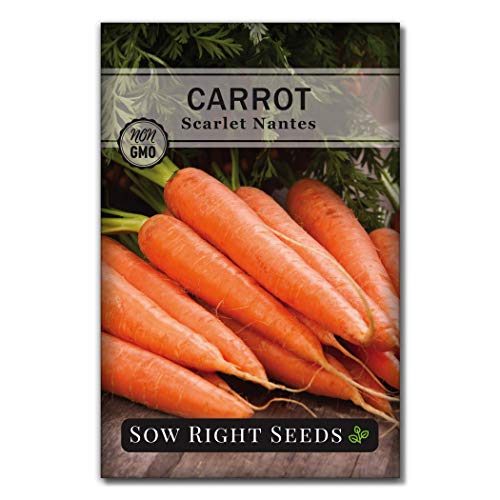
Sow Right Seeds Scarlet Nantes Carrot Seed
Nantes roots are cylindrical and blunt, 6 to 7 inches long: a fit for most loose beds.
Check price on Amazon
Survival Garden Seeds Danvers 126 Carrot Seeds
Chantenay roots suit shallow, heavy soils better than long types; Danvers roots run up to 7 inches.
Check price on Amazon
Seed Needs Paris Market Carrot Seeds
Stump-rooted or round carrots suit heavy clay soil or container gardening.
Check price on Amazon
Luster Leaf 1601 Rapitest Soil Test Kit
Guides aim for a pH of 6.0 to 6.5 or 6 to 7; a test shows whether the bed needs lime or fertilizer before sowing.
Check price on Amazon
Sources we used
Every carrot figure in this guide traces back to one of the pages listed here, and a saved copy of each one backs it up. Where the guides part ways, you get the spread or both views.
- "University of Maryland Extension: Growing Carrots in a Home Garden" (updated February 20, 2023)
- "Illinois Extension, Home Vegetable Gardening: Carrots"
- "Clemson Cooperative Extension, HGIC 1305: Carrot, Beet, Radish and Parsnip" (revised 2016)
- "University of Minnesota Extension: Growing carrots and parsnips in home gardens"
- "NOAA NCEI: U.S. Climate Normals, 1991-2020": median first and last 32 F dates for Washington Reagan, Chicago O'Hare, Atlanta Hartsfield and Minneapolis-St. Paul airports
Related guides
- How long seeds last, with a paper towel test to try on an old packet before sowing.
- How to grow kale, another crop that sweetens after frost.
- How to grow arugula, a quick cool-season green to sow beside the carrot row.
- Sprouts on the kitchen counter, a winter crop that needs no garden at all.
- How to grow onions, bulbs for the same early season.
- How to grow leeks, another harvest that can wait in the bed.
- Swiss chard, a leafy crop for the same spring and fall beds.
Frequently asked questions
When should I plant carrots?
Plant carrots in spring once the soil reaches at least 45 F, or by another guide as soon as the ground can be worked, and again 10 to 12 weeks before your first fall frost. At Chicago O'Hare, where the median first 32 F date is October 28, the fall sowing falls in early to mid August.
How deep do you plant carrot seeds?
In spring, set carrot seed 1/4 to 1/2 inch down. Summer sowings in drier soil may go 1/2 to 3/4 inch, and one guide covers seed with only 1/8 inch of vermiculite or potting soil to stop a crust. Sow in place, because transplanting damages the taproot.
How long do carrots take to grow?
Most carrots are ready about 65 to 75 days after sowing (about 60 to 70 for non-finger types in one guide), and finger carrots are usually ready in 50 to 60 days. The seed is slow to start: it can take up to two or three weeks to come up, so keep the seedbed damp.
When should I harvest carrots?
Harvest carrots once the roots reach the size you want, usually about 65 to 75 days after sowing. One guide lets non-finger varieties reach at least 3/4 inch across and then picks over 3 to 4 weeks, while another pulls carrots for fresh use before they pass 1 inch. Brush back the soil to check the shoulders.
How far apart should carrots be thinned?
Thin to about 1 to 4 inches apart depending on the variety and the size you want. The guides give 2 to 3 inches, about 2 to 4 inches and 1 to 4 inches; small finger carrots can stand closer, and large Danvers or Chantenay types need more room.
What can I plant with carrots?
Radishes are the classic partner: sow them with the carrots and pull the radishes before the carrots need the room. Carrots planted near tomatoes get shade, and pairing deep taproots like carrots with shallow-rooted onions and lettuce makes their roots less likely to get in each other's way.
Can carrots stay in the ground over winter?
Yes, in many areas: a heavy mulch of straw or shredded leaves, laid before the ground freezes, lets you dig carrots through the winter. Two tips: keep snow off the row under a mulch, a row cover or a low tunnel, and dig on days above freezing.
Why are my carrots forked?
Forking usually comes from stones, clods or compacted soil, deep cultivation, root-knot nematodes or drought. Poorly prepared soil is the most frequent cause, so loosen the bed 8 to 9 inches deep before sowing, break up clods, and hoe shallowly once the seedlings are up.