
Sprouting Seeds: How to Grow Sprouts in a Jar, From Broccoli to Mung Bean
Soak seed sold for sprouting, then rinse and drain it at least twice a day in a jar kept out of direct sun. Broccoli, alfalfa, radish, lentil and mung bean sprouts take roughly 2 to 7 days. Raw sprouts carry a risk of foodborne illness; the FDA says higher-risk groups should avoid them.
Sources: U.S. Food and Drug Administration, Penn State Extension, University of Vermont Extension, University of Saskatchewan and 3 more. See the sources we used. How we source our guides

On this page (9)
To grow sprouts, soak a tablespoon or two of seed sold for sprouting in a clean jar of water (small seeds such as broccoli for about 4 to 8 hours, beans overnight), drain it, then rinse and drain at least twice a day, keeping the jar out of direct sun. Broccoli, alfalfa, radish, lentil and mung bean sprouts are ready in roughly 2 to 7 days, depending on the seed. Give them a final rinse, drain them well and refrigerate them. First, read the food safety section: raw sprouts carry a real risk of foodborne illness.
A wide-mouth jar with a screen lid and seed sold for sprouting are all the method needs; both are in the supplies section near the end.
For herbs on the same counter, see the best indoor herb gardens.
Sprouts are a crop you can grow indoors all winter, because they need no soil, no garden and no grow light. A jar, a screen lid and seed are the whole kit. This guide follows two U.S. Food and Drug Administration pages for the safety rules, three university extension pages for the method, and two seed company instruction sheets for the soak times and days by seed, and it shows where those sources give different numbers.
| Seed | Seed sold for sprouting and tested for pathogens (U. of Saskatchewan) |
|---|---|
| Soak | 4 to 8 hours for small seed such as broccoli; overnight, or 12 to 15 hours, for beans (White Flower Farm, U. of Vermont) |
| Rinse and drain | At least twice a day, three times preferred (U. of Saskatchewan) |
| Temperature | About 60 to 70 F, in the dark (Johnny's) |
| Light | None until the final hours; never direct sun (White Flower Farm, U. of Saskatchewan) |
| Days to harvest | About 2 to 7, by seed (Johnny's chart) |
| Storage | Refrigerator at 40 F or below (FDA); about five days to a week (U. of Vermont, Johnny's) |
| Food safety | Higher-risk groups should avoid "raw or lightly cooked sprouts of any kind" (FDA) |
Food safety first
Every source that covers home sprouting raises the same issue, and the FDA states it plainly. Sprouts grow from seeds under warm, humid conditions, and those conditions also suit bacteria such as Salmonella, Listeria and E. coli. If a seed carries even a few harmful bacteria, they can multiply to high levels while the seed sprouts. The FDA notes this holds "even if you are growing your own sprouts under sanitary conditions at home." In other words, a clean kitchen does not remove the risk, because the problem usually starts with the seed.
The scale of it: an FDA guidance announcement counts 52 reported outbreaks of foodborne illness tied to contaminated sprouts between 1996 and 2020, with more than 2,700 cases, and says seed has historically been identified as the likely source in many of them.
What the FDA pages add for everyone else:
- Cold storage. Keep perishable produce in a clean refrigerator at 40 F or below, and check it with a refrigerator thermometer.
- Clean hands. Wash with soap and warm water for at least 20 seconds before and after handling produce.
- Rinsing has limits. Rinsing under running water can reduce whatever bacteria may be there but will not eliminate them, and the FDA advises against washing produce with soap or detergent.
- Seed for sprouting. The FDA treats seed used for sprouting as food and has issued guidance to the firms that grow and condition it. For the jar at home, the University of Saskatchewan's advice is to buy seed that is sold for sprouting and has been tested for pathogens. Johnny's Selected Seeds, for one, says its sprouting seed is untreated and has tested negative for E. coli O157 and Salmonella.
What you'll need for sprouts
As an Amazon Associate we earn from qualifying purchases.

Todd's Seeds Broccoli Sprouting Seeds
Ready in 3 to 7 days, picked at 1 1/2 to 2 inches.
Check price on Amazon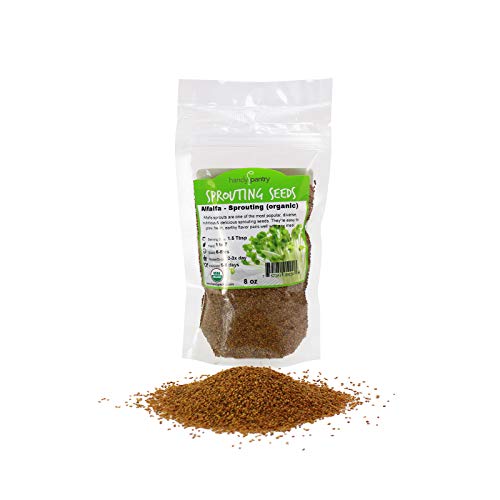
Handy Pantry Alfalfa Sprouting Seed
Ready in 3 to 5 days, picked at 1 1/2 to 2 inches.
Check price on Amazon
Nature Jim's Sprouts Mung Bean Sprouting Seeds
Ready in 4 to 6 days, picked at 1 to 2 inches.
Check price on Amazon
Kitmiido Seed Sprouting Jar Kit
A wide-mouth jar with a screen or mesh lid, so the seed drains between rinses.
Check price on Amazon
The jar method, step by step
The method below combines the University of Vermont Extension, University of Saskatchewan, White Flower Farm and Johnny's instructions. Where they differ on a number, the next section shows each figure.
- Set up a clean jar. A wide-mouth canning jar works; Johnny's uses a 1 quart or half gallon size. Cover the mouth with a sprouting lid, a square of nylon mesh held by a rubber band, or cheesecloth. Vermont's first step is to wash the container in hot, soapy water.
- Measure the seed. Start with about 1 tablespoon of small seed (broccoli, alfalfa, radish) or 2 tablespoons to a quarter cup of lentils or mung beans; the sources' amounts and what they turn into are in the table below.
- Soak. Cover the seed with clean water near room temperature. White Flower Farm uses about three times the seed's own depth of water. Soak times run from 4 hours for small seed to overnight or 12 hours or more for beans.
- Drain and rinse. Pour the soak water off through the screen, rinse with fresh water and drain again. Vermont props the jar upside down in a bowl so it keeps draining; Johnny's lays it on its side. The goal is seed that stays damp but never sits in water.
- Keep it dark and mild. Put the jar in a cupboard or under a towel, at about 60 to 70 F. White Flower Farm calls 65 to 70 F ideal: much cooler and the seed is slow, much warmer and mold can grow.
- Rinse and drain on a schedule. At least twice a day, morning and evening, with three times better according to Saskatchewan. White Flower Farm rinses 2 to 4 times a day.
- Green them up. When the first small leaves appear, move the jar to a bright spot that gets no direct sun for the final hours or day. White Flower Farm does this for the last 24 hours; Johnny's for a few hours.
- Harvest. Vermont calls them ready once leaves show and the seed hulls start to drop. Rinse the hulls away or skim them off; Johnny's notes they are harmless to eat but spoil faster in storage.
Two things often look like trouble but are not. The fine white fuzz on the roots of many sprouts is root hairs, which White Flower Farm says should not be confused with mold. And not every batch works: Vermont says to throw out sprouts with black spots, brown discoloration or slime, and traces most failures to poor airflow or water left standing in the jar.
Soak, rinse and days by seed
The two seed company sheets and the three extension pages each give their own soak times and days to harvest. The table puts them side by side for the five seeds most people start with. Treat the ranges as a guide and taste as you go: sprouts are ready when they look and taste the way you like, within the window.
| Seed | Soak | Days (Johnny's) | Days (White Flower Farm) | Harvest length (Johnny's) | Seed to sprouts |
|---|---|---|---|---|---|
| Broccoli | 4 h (WFF); 6 h (USask); 6 to 8 h (UVM); overnight (Johnny's) | 5 to 7 | 3 to 5 | 1 1/2 to 2 in | 1 Tbs to about 1 to 1 1/2 cups (Johnny's); 1 Tbs to 1 cup (WFF) |
| Alfalfa | 6 to 8 h (UVM); overnight (Johnny's) | 3 to 5 | Not listed | 1 1/2 to 2 in | 1 Tbs to about 1 1/2 cups (Johnny's) |
| Radish | 4 h, small seed (WFF); 6 h (USask); overnight (Johnny's) | 2 to 5 | 3 to 5 | 1/2 to 1 1/2 in | 1 Tbs to about 1 to 1 1/2 cups (Johnny's); 1 Tbs to 1 cup (WFF) |
| Lentil | Overnight (Johnny's) | 2 to 3 | 3 to 4 | 1/2 to 3/4 in | 1/4 cup to about 1/4 cup (Johnny's); 2 Tbs to 1 3/4 cups (WFF) |
| Mung bean | Overnight (UVM, Johnny's); 12 h (USask); 12 to 15 h (WFF) | 4 to 5 | 4 to 6 | 1 to 2 in | 1/4 cup to 1 cup (Johnny's); 2 Tbs to 2 cups (WFF) |
WFF = White Flower Farm (its table heads the column Days to germinate); USask = University of Saskatchewan; UVM = University of Vermont Extension. Johnny's soaks every seed overnight in a jar half full of lukewarm water.
The pattern behind the numbers is seed size. Vermont gives small seed (alfalfa, broccoli) 6 to 8 hours in water and big seed such as mung beans a night, and suggests estimating by size when a packet gives no figure. Saskatchewan uses six hours for small seed and twelve for beans and peas. White Flower Farm is shortest at 4 hours for broccoli and longest at 12 to 15 hours for beans. Johnny's soaks everything overnight.
How to grow broccoli sprouts
Broccoli is the slowest of the small seeds in Johnny's chart at 5 to 7 days, picked at 1 1/2 to 2 inches; White Flower Farm says 3 to 5 days. Soak it 4 hours (White Flower Farm) to 6 to 8 hours (Vermont), then rinse on the usual schedule. For broccoli grown in the garden, see our guide to brassicas.
How to grow alfalfa sprouts
Alfalfa runs 3 to 5 days and 1 1/2 to 2 inches long in Johnny's chart, with a mild, nutty flavor, after a 6 to 8 hour soak by Vermont's count. Penn State Extension notes that alfalfa and clover sprouts are the kinds most often involved in reported outbreaks, so the food safety section above applies here first.
How to grow mung bean sprouts
Mung beans are big seed, so they soak longest: overnight for Vermont and Johnny's, 12 hours for Saskatchewan, 12 to 15 for White Flower Farm. They take 4 to 5 days in Johnny's chart and 4 to 6 in White Flower Farm's, at 1 to 2 inches; a quarter cup of seed makes about a cup of sprouts in Johnny's chart, and White Flower Farm gets 2 cups from 2 tablespoons. Our edamame guide also covers lentil and mung bean sprouts beside the garden legumes.
Radish and lentil sprouts
- Radish. 2 to 5 days in Johnny's chart and 3 to 5 in White Flower Farm's, harvested at 1/2 to 1 1/2 inches. Johnny's describes the flavor as peppery and spicy. To grow the root itself outdoors, see how to grow radishes.
- Lentil. Quick at 2 to 3 days (Johnny's) or 3 to 4 (White Flower Farm), harvested short at 1/2 to 3/4 inch.
Saskatchewan notes that germination alone can take anywhere from 1 to 12 days depending on the seed, and that spread is why a mixed jar is hard to time: one seed is ready while another is still swelling. Sprout one kind per jar, or mix only seeds with similar days in the chart.
Sprouts vs microgreens
The two are easy to confuse because some seeds (broccoli, radish) are sold for both. The difference is the stage and what you eat. Iowa State University Extension explains that sprouts are picked a day or two after the seed germinates and eaten whole, seed, root and seed leaves included, while microgreens are older seedlings usually cut at the first true leaf stage, and only the stem and leaves are eaten.
Clemson Extension's Home and Garden Information Center adds the growing difference: microgreens grow in soil, and only the parts above the soil are eaten, harvested as true leaves begin to form at about 1 to 3 inches tall. Sprouts, as Saskatchewan puts it, grow in water rather than soil. That is also why the food safety advice above singles out sprouts: the whole seed and root are eaten, often raw.
In practice, a sprouting jar on the counter is a 2 to 7 day project with no light needed until the end. Microgreens take a tray, a growing mix and a bright window or light, and they are a separate guide. For the light, see our picks for the best grow lights.
Storing sprouts
Finish every batch the same way: a last rinse, a thorough drain, and as much surface water removed as you can (Vermont pats them dry). Then refrigerate at 40 F or below, the FDA's figure for perishable produce, in a clean covered container.
How long they keep is where the sources disagree most:
- Vermont: most kinds last about five days in the refrigerator.
- Johnny's: up to a week.
- Saskatchewan: up to two weeks in a sealed container, rinsed with cool water every two days.
Go by the shorter figure and by your eyes and nose. Penn State Extension's summary of FDA tips is not to eat sprouts that are past their recommended shelf life or look slimy or discolored, and Vermont's discard signs (black spots, brown color, slime) apply in the refrigerator as much as in the jar. Removing the loose hulls before storing, as Johnny's suggests, also slows spoilage.
If anyone in the household is in a higher-risk group, cook their portion or leave sprouts off their plate. Thorough cooking is the step the FDA says kills harmful bacteria.
Sprouting seeds and supplies
Buy seed packed and sold for sprouting, not garden packets, and start with one kind: broccoli for a peppery sprout, alfalfa for a mild one, or mung beans for the crunchy kind used in stir-fries. A wide-mouth jar with a screen sprouting lid is the only equipment the method needs.
Sources we used
Every soak time, rinse count and day count on this page comes from the pages listed next, with a saved copy of each behind it. Food safety statements are quoted from the FDA or credited to it, and when two growing sources disagree, both figures appear.
- "U.S. Food and Drug Administration: Selecting and Serving Produce Safely"
- "U.S. Food and Drug Administration: FDA Issues Final Guidance for Seeds Used for Sprouting"
- "Penn State Extension: What You Should Know About Sprouts"
- "University of Vermont Extension: growing sprouts at home"
- "University of Saskatchewan, Gardening at USask: Sprouts"
- "White Flower Farm: Growing Sprouts" (instructions and seed table)
- "Johnny's Selected Seeds: Sprouting Seeds instructions, tech sheet 8969" (revised 2018)
- "Iowa State University Extension: How to Grow Your Own Microgreens" and "Clemson HGIC: Growing Microgreens"
Related guides
- How long garden seeds last, and the paper towel test for packets meant for planting, not for the jar.
- How to grow kale, a winter-hardy green for the garden.
- How to grow arugula, which also grows on a sunny windowsill.
- How to grow carrots, including carrots left in the ground through winter.
- How to grow radishes, the garden root behind the peppery sprouts.
- Growing brassicas, the family that broccoli and radish seed come from.
Frequently asked questions
How do you grow broccoli sprouts?
Soak about 1 tablespoon of broccoli seed sold for sprouting for 4 to 8 hours, then rinse and drain it at least twice a day in a jar kept out of direct sun. White Flower Farm puts broccoli at 3 to 5 days and Johnny's chart at 5 to 7 days; harvest at about 1 1/2 to 2 inches.
How do you grow sprouts in a jar?
Soak the seed in clean water, pour it off through a screen or sprouting lid, then rinse and drain at least twice a day, or three times as the University of Saskatchewan prefers. Keep the jar dark at about 60 to 70 F (Johnny's), then give it bright light without direct sun for the final hours.
How do you grow alfalfa sprouts?
Soak a tablespoon of alfalfa seed for 6 to 8 hours (University of Vermont) or overnight (Johnny's), then rinse and drain it twice a day in a dark spot. Johnny's chart has alfalfa ready in 3 to 5 days at 1 1/2 to 2 inches. Penn State Extension says alfalfa and clover sprouts are most often involved in outbreaks.
How do you grow bean sprouts?
Grow mung bean sprouts like any jar sprout with a longer soak: overnight for the University of Vermont and Johnny's, or 12 to 15 hours for White Flower Farm. Rinse and drain twice daily in the dark. Johnny's chart has them in 4 to 5 days at 1 to 2 inches; White Flower Farm says 4 to 6 days.
Are homegrown sprouts safe to eat?
Raw sprouts carry a risk of foodborne illness even from a clean home kitchen, the FDA says, because bacteria on the seed can multiply during sprouting. It says "Children, older adults, pregnant women, and people with weakened immune systems" should avoid "raw or lightly cooked sprouts of any kind"; cooking kills harmful bacteria.
Can I sprout regular garden seeds?
Use seed that is sold for sprouting. The University of Saskatchewan recommends seed sold for sprouting and tested for pathogens, and the FDA's industry guidance on seed for sprouting asks for higher food safety precautions than for seed grown for other uses.
What is the difference between sprouts and microgreens?
Sprouts are harvested a few days after germination and eaten whole, seed and root included, and they grow in water. Microgreens grow in soil and are usually cut at the first true leaf stage, and only the stem and leaves are eaten, according to Iowa State and Clemson Extension.
How long do sprouts last in the fridge?
Most sprouts keep about five days in the refrigerator according to the University of Vermont, and up to a week according to Johnny's, at 40 F or below, the FDA's figure. Saskatchewan gives up to two weeks with a rinse every two days, but throw out any sprouts that turn slimy or discolored.