
Best Seedling Heat Mats (2026): 4 Picks
A heat mat for one flat, a shelf of four, a bench that gets wet and two flats side by side.
As an Amazon Associate we earn from qualifying purchases.
Top picks

Our pick for one flat of seeds
1. VIVOSUN 10 x 20.75 Inch Heat Mat and Thermostat
A 20-watt mat the size of one flat, sold with a digital thermostat you set from 68 to 108 F.

Our pick for a shelf of four flats
2. VIVOSUN 48 x 20.75 Inch Heat Mat and Thermostat
The same set at 48 inches and 105 watts: four flats side by side under one probe.
Our pick for a bench that gets wet
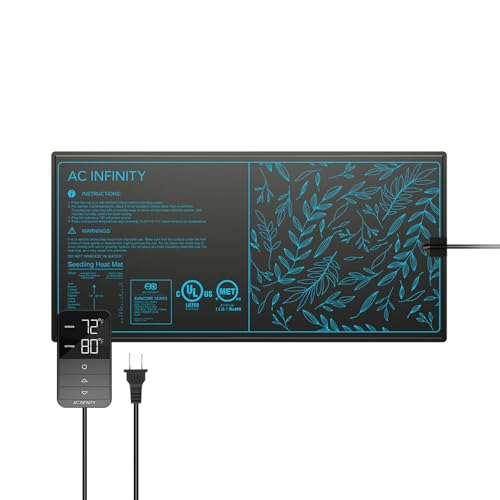
The one pick with a stated IP-67 waterproof code, sealed at the seams and cord joint.

Our pick for two flats side by side
4. Hydrofarm Jump Start 20 x 20 Inch Heat Mat
A 45-watt, UL-listed mat with a 6-foot cord for two flats; add a thermostat to hold a set temperature.

On this page (12)
The best seedling heat mat for most seed starters is the VIVOSUN 10 x 20.75 Inch Heat Mat and Thermostat, because it is a 20-watt mat the size of one flat that can warm the mix roughly 10 to 20 F above the room, sold with a digital thermostat that holds it at the temperature you set. For a shelf of four flats, the 48-inch VIVOSUN set; for a bench that gets wet, the AC Infinity SUNCORE H3; and for two flats side by side, the Hydrofarm Jump Start 20 x 20 inch mat, plus a thermostat. Already own a plain mat? See the add-on thermostat under the picks.
Start here: which seedling heat mat for your setup
- One flat of tomatoes, peppers or flowers: VIVOSUN 10 x 20.75 Inch Heat Mat and Thermostat (pick 1).
- A shelf or rack with four flats: VIVOSUN 48 x 20.75 Inch Heat Mat and Thermostat (pick 2).
- A bench that gets wet: AC Infinity SUNCORE H3 (pick 3).
- Two flats side by side: Hydrofarm Jump Start 20 x 20 Inch Heat Mat (pick 4), plus a thermostat.
- A mat you own with no thermostat: the Hydrofarm Jump Start Heat Mat Thermostat, under the picks.
- Only lettuce or onions, in a room in the 60s F: you may not need a mat (see the crop table).
The fork is the thermostat. A plain mat warms the mix about 10 to 20 F above the room for as long as it is plugged in. A thermostat reads the temperature (through a probe in the mix on picks 1 and 2 and the add-on thermostat) and switches the mat on and off to hold the number you set.
The picks, by job
Specs on each card are the maker's own.
1. VIVOSUN 10 x 20.75 Inch Heat Mat and Thermostat: our pick for one flat of seeds
Best for: One flat of tomatoes, peppers or flowers
- Size: 10 x 20.75 in
- Power: 20 W
A 10 by 20.75 inch mat that puts out a steady 20 watts, sold as a set with a digital thermostat you set from 68 to 108 F through a sensor probe. Its manual puts the rooting area roughly 10 to 20 F above the room air.
Why it is our pick: The thermostat keeps the mat from running past what each crop wants: in a 70 F room, a mat alone could land the mix at about 80 to 90 F (70 plus roughly 10 to 20), at or past the top of lettuce's optimum range. The mat is water-resistant enough to scrub, with a reinforced joint where the cord meets it.
Good to know: No waterproof rating or cord length is given, and the manual says never to immerse it. In a room near 68 F it takes about 30 minutes to warm up, and an insulated surface beats a cold floor.
2. VIVOSUN 48 x 20.75 Inch Heat Mat and Thermostat: our pick for a shelf of four flats
The same pairing at 48 by 20.75 inches: a mat that puts out a steady 105 watts, with the same 68 to 108 F digital thermostat. The rise is the same, roughly 10 to 20 F over the room air.
Why it is our pick: Four flats 11 inches wide take 44 of its 48 inches, so one mat and one probe heat the whole shelf instead of four mats and four controllers.
Good to know: One probe means one setting, so share it among flats that want the same temperature, such as peppers and eggplant, and keep lettuce elsewhere. As with pick 1, no waterproof rating or cord length, and never immerse it. At 105 watts for 24 hours, that works out to at most about 2.5 kWh a day.
3. AC Infinity SUNCORE H3: our pick for a bench that gets wet
Best for: Bottom watering, misting or spills
A 10 by 20.75 inch mat drawing 20 watts at most, with a digital controller. It is the one pick with a stated waterproof rating, IP-67, with the seams and the cord joint sealed against water and dust. Its rise is up to 20 F over the room air. The controller sets the mat's surface temperature and reads its own sensor; there is no probe for the mix.
Why it is our pick: Watering from below and misting put water where the mat and cord sit, and this is the pick sealed for it. Its far-infrared film, its maker says, spreads the warmth evenly across the mat.
Good to know: Its manual still says never to use it outdoors or submerge it. Its spec sheet gives a temperature range of 80 to 87 F and its product page 32 to 122 F, and neither gives a cord length. In a cold room it may not reach the setting.
4. Hydrofarm Jump Start 20 x 20 Inch Heat Mat: our pick for two flats side by side
A 20 by 20 inch, 45-watt, UL-listed mat with a 6-foot power cord and growing notes printed on its face. It warms the root zone about 10 to 20 F above the room air; to keep the root zone steady, add a digital thermostat (under the picks).
Why it is our pick: Two 11-inch-wide flats side by side make 22 inches on its 20, so their rims sit about an inch past each edge, and it is the one mat here with a listed cord length.
Good to know: Its instructions list this size as 20 by 20.75 inches. Never put it inside the tray, bury it in mix or lay insulating material over it, which could make it overheat, and do not immerse it; it is called waterproof, but no rating is given.
You will also need: a thermostat for pick 4 or a plain mat you already own. The Hydrofarm Jump Start Heat Mat Thermostat, a digital controller the mat plugs into. Set it from 68 to 108 F, push its stainless steel probe about 1 to 1 1/2 inches into the mix, and it switches the mat on and off to hold that number. It carries up to 1,000 watts (8.3 amps), so several mats can share it, and it works with every Jump Start mat and most other seedling heat mats. Mount the controller up and away from trays and water and never submerge it; it shuts off if the probe reaches 108 F.
How we chose these
Our field was electric mats made for seed starting. From each maker's product page and manual, we kept mats with a stated size, wattage and rise over room air, one per job, and for the add-on, a thermostat with a stated range and load. The crop temperatures come from university extension pages, and the how-to steps from those pages and the makers' manuals, all listed under Sources. The table sets those published specs side by side; we did not start seeds on these mats ourselves.
Our editorial policy says how we find, check and number the picks in every buying guide.
Also considered
VIVOSUN 10 x 20.75 inch mat without the thermostat. Pick 1's 20-watt mat sold alone; its manual says it is always on once plugged in.
Hydrofarm Jump Start 48 x 20 inch mat. 107 watts and no thermostat of its own; pick 2 includes one at that width.
AC Infinity SUNCORE S3. Its controller is a knob that turns between low, medium and high heat, with no number to dial in.
Spec by spec: the four picks side by side
| Pick | Size, inches | Watts | Thermostat | Rise over room air | Waterproof rating | Cord length | Flats side by side (worked out) | Most kWh a day (worked out) |
|---|---|---|---|---|---|---|---|---|
| 1. VIVOSUN 10 x 20.75 Inch Heat Mat and Thermostat | 10 x 20.75 | 20 | Included, set 68 to 108 F | Roughly 10 to 20 F | Not given (water-resistant; do not immerse) | Not given | 1 | About 0.48 |
| 2. VIVOSUN 48 x 20.75 Inch Heat Mat and Thermostat | 48 x 20.75 | 105 | Included, set 68 to 108 F | Roughly 10 to 20 F | Not given (water-resistant; do not immerse) | Not given | 4 | About 2.5 |
| 3. AC Infinity SUNCORE H3 | 10 x 20.75 | 20 at most | Included, a digital controller that sets the mat's surface temperature | Up to 20 F | IP-67 | Not given | 1 | About 0.48 |
| 4. Hydrofarm Jump Start 20 x 20 Inch Heat Mat | 20 x 20 (20 x 20.75 in its instructions) | 45 | Sold separately | About 10 to 20 F | Not given (called waterproof; do not immerse) | 6 feet | 2, rims about 1 inch past each edge | About 1.1 |
One heavy-duty 1020 tray measures 11.0 by 21.1 inches outside, so its rim runs about half an inch past a 10 by 20.75 inch mat on each long side, while its 9.4 by 19.9 inch bottom stays on the mat. Divide each mat's watts by its area and every mat here comes to about 14 to 16 watts per square foot, so a bigger mat is wider, not hotter. We measured none of this ourselves.
Do you need a thermostat for a seedling heat mat?
For most setups, yes, and our pick comes with one. A mat without a controller heats the whole time it is plugged in, so the mix ends up at whatever the room is plus the mat's roughly 10 to 20 F. In a 60 F basement that is about 70 to 80 F, inside the optimum range for tomatoes; in a 70 F room it is about 80 to 90 F, at or past the top of lettuce's optimum range. A germination mat with a thermostat holds the mix at one even temperature.
You can do without one if the room holds steady in the low 60s F, every flat is a warm-season crop, and you check the mix with a probe thermometer. Without any mat, a warm place in the house, such as near a heat register, usually does the job; a mat earns its place in a cool room. Never swap in an ordinary heating pad: unprotected, it may be a shock or fire risk.
What soil temperature do seeds need to sprout?
For most seed, a mix at about 65 to 75 F is a good target, and most will sprout anywhere from 68 to 86 F. Warm mix gets most seeds up sooner and with healthier roots, and heat from below can help guard against damping off. Set the thermostat for the crop on the mat. In the table, the lowest and highest are the limits given for germination; where the two charts in our Sources differ, the cell gives both ends.
| Crop | Lowest (F) | Optimum range (F) | Highest (F) | Days at 59 F | Days at 68 F | Days at 77 F | Days at 86 F |
|---|---|---|---|---|---|---|---|
| Tomato | 50 | 60 to 85 | 95 | 13.6 | 8.2 | 5.9 | 5.9 |
| Pepper | 60 | 65 to 95 | 95 | 25.0 | 12.5 | 8.4 | 7.6 |
| Eggplant | 60 | 75 to 90 | 95 | Left out: the charts put its days under different temperatures | |||
| Cauliflower | 40 | 45 to 85 | 95 to 100 | 9.9 | 6.2 | 5.2 | 4.7 |
| Lettuce | 32 to 35 | 40 to 80 | 85 to 95 | 3.9 | 2.6 | 2.2 | 2.6 |
| Onion | 32 to 35 | 50 to 95 | 95 | 7.1 | 4.6 | 3.6 | 3.9 |
| Parsley | 40 | 50 to 85 | 90 to 95 | 17.0 | 14.0 | 13.0 | 12.3 |
| Cucumber | 60 | 60 to 95 | 105 | 13.0 | 6.2 | 4.0 | 3.1 |
| Muskmelon | 60 | 75 to 95 | 100 to 105 | Not tested | 8.4 | 4.0 | 3.1 |
| Watermelon | 60 | 70 to 95 | 105 | Not tested | 11.8 | 4.7 | 3.5 |
Reading the table: of the crops with a 59 F figure, peppers gain the most from a mat, about 25 days to sprout at 59 F against 8.4 at 77 F. Tomatoes take about 6 to 8 days at 65 to 85 F, and at 50 F they may still sprout but take over 40. Lettuce is up in 3.9 days at 59 F and its optimum range ends at 80 F, so a mat can push it too warm.
How to use a seedling heat mat
- Set the mat flat on an insulating surface, not a bare cold floor, then put the tray on top. Never put the mat inside the tray, bury it in mix or lay insulating material over it.
- Push the thermostat probe about 1 to 1 1/2 inches into the mix, and set the number for the crop from the table above.
- Cover the tray with a clear dome: it holds in moisture and can help keep the root zone warm. Lift it off once the seedlings reach it.
- Plug the mat into its own outlet, not the timer that runs your grow lights.
- Check the mix often. Too much heat can dry out the mix and kill seedlings; keep it moist, not wet, since standing water could lead to damping off.
- Once about half the seeds are up, take the tray off the mat or turn it down, and give the seedlings bright light (see the FAQ for the cooler temperatures they want).
Even with a mat, the air matters: keep the room above 60 F, since the mix in a container can be up to 5 F colder than the room air.
What to look for in a seedling heat mat
- Size to your flats: 10 by 20.75 inches for one flat, 20 inches wide for two, 48 for four.
- A thermostat: sold with the mat, with a probe in the mix (picks 1 and 2) or its own sensor (pick 3), or added to a mat you own (the add-on thermostat under the picks).
- A waterproof rating: only if water reaches the mat; IP-67 on pick 3.
- A safety listing: each pick's maker cites a UL or MET certification or standard; never an ordinary heating pad.
Sources
- "UC Master Gardener Program, UC ANR: Seed germination temperature and timing"
- "Oregon State University Extension Service: Soil temperature conditions for vegetable seed germination"
- "University of Minnesota Extension: Starting seeds indoors"
- "University of Maryland Extension: Starting vegetable seeds indoors"
- "Iowa State University Extension and Outreach: Do I need to purchase a heat mat to successfully germinate seeds indoors?"
- "Iowa State University Extension and Outreach: How to successfully start seed indoors"
- "Penn State Extension: Sowing annual seeds"
- "VIVOSUN: 10 x 20.75 seedling heat mat and digital thermostat combo set"
- "VIVOSUN: Seedling heat mat digital thermostat combo, 48 x 20.75"
- "VIVOSUN: 10 x 20.75 seedling heat mat manual"
- "VIVOSUN: 48 x 20.75 seedling heat mat manual"
- "AC Infinity: SUNCORE H3 seedling heat mat with heat controller"
- "AC Infinity: SUNCORE seedling heating mat user manual"
- "Hydrofarm: Jump Start seedling heat mat, 20 x 20, 45W"
- "Hydrofarm: Seedling heat mat instructions"
- "Hydrofarm: Jump Start digital temperature controller for heat mats"
- "Hydrofarm: Jump Start heat mat thermostat instructions"
- "Bootstrap Farmer: 1020 extra strength trays"
Related guides
- Seed starting trays, the flats, cells and domes that sit on a mat.
- Grow lights for seedlings, for the light they need once off the mat.
- Starting seeds indoors, from sowing and bottom heat to hardening off.
- Growing peppers, including when to start pepper seeds indoors.
- Growing tomatoes, including how to start tomato seeds indoors.
Frequently asked questions
What is the best seedling heat mat?
For one flat, the VIVOSUN 10 x 20.75 Inch Heat Mat and Thermostat, a mat sold with a digital thermostat that holds the mix where you set it. For a shelf of four flats, the 48-inch VIVOSUN set; for a bench that gets wet, the AC Infinity SUNCORE H3; for two flats side by side, the Hydrofarm Jump Start 20 x 20 inch mat, plus a thermostat.
Do you need a thermostat for a seedling heat mat?
For most setups, yes. A mat alone adds about 10 to 20 F to the room for as long as it is plugged in, so a warm room can push the mix past what a crop wants; a thermostat holds the number you set. A steady room in the low 60s F with only warm-season crops on the mat can do without one.
What temperature should a seedling heat mat be set to?
Set it to about 65 to 75 F in the mix for most seed; peppers sprout fastest in the high 70s to mid 80s F, and tomatoes come up in about 6 days at 77 to 86 F. Peppers take about 8 days there against 25 at 59 F. Lettuce gains little: it is up in about 4 days at 59 F.
When should you take seedlings off the heat mat?
Once about half the seeds have sprouted, lift the tray off or turn the mat down. A seedling's optimum growing temperature is about 10 F below the optimum for sprouting its seed, so it can take cooler nights of roughly 55 to 60 F and days of 65 to 70 F, and it needs bright light.
Should a heat mat share the grow light timer?
No. Lights run on a timer for part of the day, while most seeds need consistently warm mix until they sprout, so plug the mat into its own outlet or into its thermostat.
How much electricity does a seedling heat mat use?
At full power for 24 hours, a 20-watt mat works out to about 0.48 kWh and the 48-inch, 105-watt mat to about 2.5 kWh. A thermostat switches the mat off once the mix is warm, so the real use is lower.
Can you use a regular heating pad to start seeds?
No. An ordinary, unprotected heating pad may be a shock or fire risk. Use a mat made for seed starting, with a thermostat to hold the temperature steady.