
Best Hydroponic Systems (2026): 5 Picks
Towers, a bucket kit and a pipe kit, each matched to one growing job.
As an Amazon Associate we earn from qualifying purchases.
Top picks

Our pick for vegetables and greens indoors
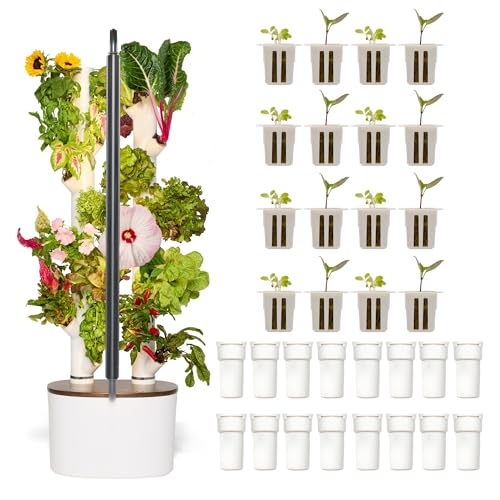
A tower that holds 30 plants in 2 square feet under two 40 W LED lights, watered and fed from its own tank.
Our pick for a small apartment
The smaller Gardyn: 16 plants in 1.4 square feet under one 52 W LED light, 54 inches tall.

Our pick for a sunny patio or balcony
An outdoor tower with 18 plants over a 20-gallon tank, with a pump, timer, plant food and pH kit in the box.

Our pick for tomatoes and peppers under grow lights
Four 5-gallon deep water culture buckets, aerated by one air pump that also runs a drip ring on top.

Our pick for rows of lettuce and leafy greens
Three tiers of pipe with 108 planting holes and a 4 W pump on a 24-hour timer.

On this page (14)
The best hydroponic system for vegetables and greens indoors is the Gardyn Home 4, because its tower holds 30 plants under its own lights in 2 square feet. For a small apartment, the Gardyn Studio 2; for a sunny patio or balcony, the Lettuce Grow Farmstand; for tomatoes or peppers under grow lights, the VIVOSUN DWC 4-Bucket Kit; for rows of lettuce and leafy greens, the VEVOR 108-Site Pipe Kit. This page covers towers, vertical units, outdoor systems and DIY bucket and pipe kits; countertop gardens such as AeroGarden and Click and Grow are in our guide to the best indoor herb gardens.
Start here: which hydroponic system for your space
- Vegetables and greens indoors, lights built in: Gardyn Home 4 (pick 1).
- A small apartment or a corner with no window: Gardyn Studio 2 (pick 2).
- A sunny patio or balcony: Lettuce Grow Farmstand (pick 3).
- Tomatoes or peppers in a grow tent or lit indoor space: VIVOSUN DWC 4-Bucket Kit (pick 4).
- Rows of lettuce and leafy greens: VEVOR 108-Site Pipe Kit (pick 5).
The picks, by job
Card specs are each maker's own.
1. Gardyn Home 4: our pick for vegetables and greens indoors
Best for: Growing indoors with no window Price class: premium
A vertical hydroponic tower that holds 30 plants in 2 square feet: 24 inches wide, 12 deep and 64 tall. Two 40 W LED lights run on automated schedules, so it needs no window, and it waters and feeds the plants from a tank of 4 gallons or more that you refill, with plant food, every 1 to 2 weeks. Seeds come in rockwool pods called yCubes; the maker's box list includes a plant starter set and plant food.
Why it is our pick: It holds the most plants of the picks that bring their own light, 30 against 16, and its sensors track the water level, humidity and temperature.
Good to know: It is an indoor system, rated for 50 to 95 F. Its seedless pods take your own seeds. The maker estimates 47 kWh a month, about 564 kWh a year by our count.
Before you buy: 3-year warranty; no noise figure given. Weekly care takes a few minutes. Ongoing cost: in the running-cost table below.
Security: Two 2026 U.S. government (CISA) advisories describe flaws that could let strangers control Gardyn kits. Fixes install themselves while the kit is online, and the app should show firmware 627 or later.
Skip it if: you want to grow outdoors, or your Wi-Fi has no 2.4 GHz band.
2. Gardyn Studio 2: our pick for a small apartment
Best for: A corner too small for a 64-inch tower Price class: mid-range
The smaller Gardyn: 16 plants in 1.4 square feet, 17 inches wide, 12 deep and 54 tall, under one 52 W LED light.
Why it is our pick: Where a 64-inch tower will not go, this one is 7 inches narrower and 10 inches shorter than the Home 4, with its own light, so a corner with no window works.
Good to know: The maker estimates 26 kWh a month, about 312 kWh a year by our count. It has one camera on the plants.
Before you buy: 3-year warranty; no noise figure given. Weekly care takes a few minutes; refill the tank with plant food every 1 to 2 weeks. Ongoing cost: in the running-cost table below.
Security: The same advisories, fixes and firmware check cover the Studio.
Skip it if: you want more than 16 plants, or your Wi-Fi has no 2.4 GHz band.
3. Lettuce Grow Farmstand: our pick for a sunny patio or balcony
Best for: A spot with 6 or more hours of full sun Price class: mid-range
- Height: 4 ft 3 in
An outdoor hydroponic tower, linked here in its 18-plant size: 6 plants on each of 3 levels over a 20-gallon tank, 22 inches across and 4 feet 3 inches tall. Its maker says it performs best in full sun, 6 hours a day or more, and that plants thrive in it at 40 to 100 F. Its maker's box list includes a water pump, a smart timer, a pH test kit and plant nutrients.
Why it is our pick: Only this tower, of the three here, is made for growing outdoors, in the sun. Its maker puts weekly care at about 15 minutes: top off the water, add nutrients, and test and adjust the pH.
Good to know: For indoor growing, the maker sells Glow Rings separately, and extension kits add levels. The maker's box list also includes starter live seedlings; check the box list where you buy. The maker recommends a water reset and a cleaning every three months.
Before you buy: 3-year warranty; no noise figure given. The three-month reset takes about 30 minutes, and each seedling generally stays 6 to 8 weeks, by variety. Ongoing cost: in the running-cost table below.
Skip it if: you have no level, sunny spot of 4 square feet with a GFCI outlet, unless you add Glow Rings indoors.
4. VIVOSUN DWC 4-Bucket Kit: our pick for tomatoes and peppers under grow lights
Best for: Four big plants indoors, a bucket each Price class: budget pick
- Air pump: 25 L/min
- Light: None
Four 5-gallon buckets in deep water culture: each plant sits in an 8-inch basket of clay pebbles over its own bucket, and one air pump blows air through air stones at the bottom of each. The same pump runs a top drip feed, so the solution recirculates. A red floating ball shows each bucket's water level.
Why it is our pick: Deep water culture is the simplest kind of hydroponics to run at home, and its maker's manual names a 5-gallon bucket as the standard size for one plant, so the kit gives four big plants a bucket each.
Good to know: Indoors, tomatoes need added heat and light that would cost too much for most gardeners; this kit is for growers who already have a grow tent or lit space, since it has no light of its own. Each bucket is about 12 inches across and 15 tall (our conversion); for a tomato, choose a container about the size of a mature plant's canopy. The manual says the kit suits seedlings and cuttings that have started rooting, so start seeds separately and move them in after they sprout.
Before you buy: Warranty: 1 year in the kit's manual, 2 years on its product page. The air pump, meant to run at all times, is rated under 40 dB and draws up to 15 W, so up to about 131 kWh a year by our count. No setup time is given, and plant food is not in the box.
Skip it if: you have no indoor grow space with a grow light and room for four 5-gallon buckets; its manual says indoor use only, though its product page also lists outdoors.
5. VEVOR 108-Site Pipe Kit: our pick for rows of lettuce and leafy greens
Best for: The most plants, in a yard, on a balcony or indoors Price class: budget pick
- Plant holes: 108
- Light: None
Three tiers of UPVC pipe with 108 planting holes, 3.15 inches apart, and a 4 W water pump on a 24-hour plug-in timer that you set to run and rest. The pipes are white outside to reflect sunlight and black inside to block light, which inhibits algae growth inside them. The maker lists it at 38.6 by 20.5 by 46.1 inches.
Why it is our pick: At 108 planting holes it holds the most plants of the picks, and its maker names lettuce first among what it grows.
Good to know: It has no light, so indoors it needs a grow light. Closer spacing reduces each plant's size, so for full heads, leave some holes empty and follow the spacing on the seed packet. No tank comes in the kit; the maker recommends your own, more than 20 liters, and the pump connects straight to it.
Before you buy: No warranty term or noise figure is given, though the pump is described as quiet. Key parts come pre-assembled, and no plant food price is given.
Skip it if: you want a kit with its own light, or full heads of lettuce in all 108 holes.
What it costs to keep running
Picks 4 and 5 need plant food, bought separately; neither product page prices it.
| Pick | Ongoing item | Maker's price | Where | Price as of |
|---|---|---|---|---|
| 1. Gardyn Home 4 | Plants, without a membership | From $4.99 each | mygardyn.com | October 30, 2026 |
| 1. Gardyn Home 4 | Optional membership: 10 plant credits a month, free shipping | $39 a month, or $29 to $34 a month prepaid | mygardyn.com | October 30, 2026 |
| 2. Gardyn Studio 2 | Plants, without a membership | From $4.99 each | mygardyn.com | October 30, 2026 |
| 2. Gardyn Studio 2 | Optional membership: 5 plant credits a month, free shipping | $25 a month, or $18 to $22 a month prepaid | mygardyn.com | October 30, 2026 |
| 3. Lettuce Grow Farmstand | Seedlings | $2.99 each, or $2.49 each in a grow pack | lettucegrow.com | October 30, 2026 |
Spec by spec: the five systems side by side
| Pick | System type | Plants (maker's spec) | Tank (maker's spec) | Light included (maker's spec) | Pump or air (maker's spec) | Warranty (maker's spec) | Noise (maker's spec) | Size (maker's spec) | Indoors or out (maker's spec) |
|---|---|---|---|---|---|---|---|---|---|
| 1. Gardyn Home 4 | Vertical tower | 30 | 4+ gallons | Yes, 2 x 40 W LED | Automatic watering | 3 years | Not given | 24 x 12 x 64 in | Indoors, 50 to 95 F |
| 2. Gardyn Studio 2 | Vertical tower | 16 | 4+ gallons | Yes, 1 x 52 W LED | Automatic watering | 3 years | Not given | 17 x 12 x 54 in | Indoors, 50 to 95 F |
| 3. Lettuce Grow Farmstand | Vertical tower | 18 | 20 gallons | No; Glow Rings sold separately | Water pump and timer | 3 years | Not given | 22 in across, 4 ft 3 in (51 in) tall | Outdoors, 6+ hours of sun; indoors with Glow Rings |
| 4. VIVOSUN DWC 4-Bucket Kit | Deep water culture with top drip | 4, one per bucket | 4 x 5 gallons | No | Air pump, 25 L/min | 1 year (manual); 2 years (product page) | Under 40 dB | Each bucket 30 x 38 cm (about 12 x 15 in) | Indoors, per its manual |
| 5. VEVOR 108-Site Pipe Kit | Pipe channels, 3 tiers | 108 | Your own; over 20 L recommended | No | 4 W water pump, 24-hour timer | Not given | No dB figure; described as quiet | 38.6 x 20.5 x 46.1 in | Yards, balconies, indoors |
The system type is our label from each maker's description.
How we chose these
We read each maker's pages, specs and manuals and kept systems with a stated plant count, light or pump, and size or tank. How hydroponics works, from pH to light, comes from the university extension pages under Sources. We did not grow in these systems ourselves.
Our editorial policy says how we find, check and number the picks in every buying guide.
Also considered
Tower Garden FLEX. Up to 20 plants and a 20-gallon tank in 30 by 30 by 50 inches, outdoors or indoors under the maker's LED lights; the Farmstand holds 18 plants in a 22-inch circle.
Rise Garden. Up to 36 small plants on each level and up to 3 levels, with a 9-gallon tank and full-spectrum LED panels; the product page gives no wattage for the lights, and no size in its text.
Hydrofarm Root Spa. One 5-gallon deep water culture bucket with an 8-inch basket and an air pump, growing media sold separately; pick 4 has four buckets, with clay pebbles in the kit.
Which type of hydroponic system do you need?
Deep water culture is the simplest to run at home: plants sit in baskets over a container of nutrient solution, their roots hanging into it, and an air stone on a pump, or an air gap above the water in a passive setup, supplies oxygen. In a nutrient film system, plants usually grow in channels or troughs over a constantly moving stream of solution that tends to be shallow; pipe kits like pick 5 also grow plants in channels, with the pump on a timer you set. Towers stack the plants up a column and water them automatically from a tank (picks 1 to 3).
No pick here is ebb and flow, a tray of substrate fed from a separate tank; soil-pod gardens are in our indoor herb garden guide.
A system that moves water with a pump stops watering when the power goes out. If that happens, plants cannot reach the water and can dry out quickly, so check on them after an outage.
What grows well in a hydroponic system?
Lettuce, herbs, and brassicas such as mustards and kale do well year-round in hydroponics, so they suit the indoor towers. Almost anything can grow hydroponically outdoors in summer, and tomatoes, cucumbers and strawberries are popular choices then. Growing those indoors takes added heat and light that would cost too much for most gardeners. Keep tomatoes and lettuce in separate containers, since their nutrient needs differ.
What pH and EC does a hydroponic system need?
Of the 17 nutrients plants need, only carbon, hydrogen and oxygen are there on their own in a hydroponic system; the rest come from the fertilizer you add, so use a hydroponic fertilizer made for your crop.
Plants do best in a slightly acidic to neutral solution, a pH of about 5 to 7 depending on the crop. EC (electrical conductivity) measures the fertilizer salts in the water: the higher the EC, the more salt. Each crop has its own range:
| Crop | pH | EC (mS/cm) |
|---|---|---|
| Lettuce | 5.5 to 7.0 (one source 5.5 to 6.0, another 6.0 to 7.0) | 1.2 to 1.8 |
| Spinach | 6.0 to 7.0 | 1.8 to 2.3 |
| Pak choi | 7 | 1.5 to 2.0 |
| Basil | 5.5 to 6.0 | 1.0 to 1.6 |
| Strawberry | 6 | 1.8 to 2.2 |
| Tomato | 6.0 to 6.5 | 2.0 to 4.0 |
| Peppers | 5.5 to 6.0 | 0.8 to 1.8 |
| Cucumber | 5.0 to 5.5 | 1.7 to 2.0 |
Test anywhere from daily, for close control of pH and EC, to every few weeks for pH in a small home system, where it is unlikely to change much once the first solution is set. Check the pH after you get the EC into range.
Do hydroponic systems need a grow light?
Indoors, almost always. Picks 1 and 2 carry their own LEDs, and the Farmstand takes the maker's Glow Rings. Picks 4 and 5 have none, so indoors they need a grow light, for hydroponic lettuce 12 to 14 hours a day and 6 to 12 inches above the plants; outdoors in summer, the sun is the simplest light for pick 5. Our indoor grow lights guide includes a pick for racks and tents of greens and herbs.
Checklist: buying a hydroponic system
- Light: built in, sold separately, or the sun.
- Plants and spacing: how many, and how close together.
- Tank: its size and how often you refill it.
- Pump or air: what runs on power, and your plan for an outage.
- Size: the footprint and height against your spot.
- Testing: a pH kit, and an EC meter for closer control.
Related guides
- Indoor herb gardens, our picks for countertop gardens with a built-in light.
- Grow lights for indoor plants, a light for each room, greens on a rack included.
- How to grow lettuce, sowing and harvest in the garden.
- How to grow kale, a leaf for spring, fall and winter harvests.
- How to grow tomatoes, from starting seed to the last harvest.
- Starting seeds indoors, timing and light for seedlings.
Frequently asked questions
What is the best hydroponic system for a beginner?
The Gardyn Home 4, for growing indoors. It brings its own lights and waters and feeds the plants from its tank; you refill the water and plant food every 1 to 2 weeks. For a sunny patio or balcony, the Lettuce Grow Farmstand.
Do hydroponic systems need sunlight?
Not if they have a light. Indoors, a hydroponic system almost always needs one, and the Gardyn picks carry their own LEDs. Outdoors in summer, the sun is the simplest light, and the Farmstand performs best in full sun for 6 hours or more.
What pH should hydroponic water be?
Slightly acidic to neutral: a pH of about 5 to 7, depending on the crop. Lettuce takes 5.5 to 7.0, tomatoes 6.0 to 6.5, peppers 5.5 to 6.0 and cucumbers 5.0 to 5.5. Check the pH after you get the EC, the fertilizer strength, into range.
How often should you change the water in a hydroponic system?
It varies: every two weeks in some advice, while for a season-long crop like tomatoes you may change it only once or twice. Leaving it unchanged suits only short crops like lettuce, which can be ready to harvest in 6 to 7 weeks. Between changes, top up with water carrying plant food at the label's rate; between plantings, empty, clean and sanitize the system.
What is the difference between DWC and NFT?
In deep water culture (DWC), roots hang into a container of nutrient solution, and an air stone on a pump, or an air gap above the water, supplies oxygen, as in pick 4's buckets. In nutrient film technique (NFT), plants usually grow in channels over a constantly moving stream of solution that tends to be shallow; pipe kits like pick 5 also grow plants in channels.
What is the main disadvantage of hydroponics?
Its dependence on power. Most systems need electricity for a pump, and indoors for a light; a long outage or an equipment failure can stress or kill plants, and a backup generator is less practical at home than for a large grower. Setup often costs more than a simple soil container garden, some assembly is required, and the water level, nutrients and pH need regular checks.
Is a hydroponic system worth it?
A hydroponic system is worth it if space or good soil is what you lack, in the city, on a balcony or on a patio: plants can grow close together and stacked up, and with the right light, lettuce, herbs, mustards and kale can grow well in it all year. It often costs more to set up than a simple soil container garden, though, and the costs go on: plants or plant food (see the running-cost table), power on most systems for a pump and, indoors, a light (about 312 to 564 kWh a year for the two Gardyn towers, by our count), and time for regular checks of the water level, nutrients and pH. Skip it for tomatoes indoors unless you already have a grow tent or lit space: the added heat and light would cost too much for most gardeners.
Sources
- "Gardyn: Gardyn Home 4"
- "Gardyn: Gardyn Studio 2"
- "CISA: Gardyn Home Kit (Update B)"
- "CISA: Gardyn IoT Hub"
- "Lettuce Grow: Original Farmstand"
- "VIVOSUN: 5 Gallon DWC Hydroponic System Kit (4 Bucket)"
- "VIVOSUN: DWC Recirculating Drip Hydroponic System Kit user manual"
- "VIVOSUN: DWC Recirculating Drip Hydroponic System Kit (4-bucket) user manual"
- "VEVOR: Hydroponics Growing System Kit, 3-Tier 108 Sites"
- "Tower Garden: Tower Garden FLEX"
- "Rise Gardens: The Rise Garden"
- "Hydrofarm: Active Aqua Root Spa 5 gal Bucket System"
- "University of Minnesota Extension: Small-scale hydroponics"
- "UC Master Gardeners of Orange County: Hydroponics for the Home Gardener"
- "University of Minnesota Extension: Lighting for indoor plants"
- "Oklahoma State University Extension: Electrical Conductivity and pH Guide for Hydroponics"
- "Purdue University: Hydroponic Lettuce Production"