
Best Electric Composters (2026): 4 Picks
Our pick for a family's daily food scraps is the FoodCycler Eco 5, which dries and grinds up to 5 liters in about 4 to 9 hours; what comes out is dried scraps, not compost. For compost rather than dried scraps, the Reencle Prime; for a small household, the FoodCycler Eco 3; for a big household that wants compost, the Reencle Gravity.

On this page
As an Amazon Associate we earn from qualifying purchases.
Our top picks
Our pick for a family's daily scraps
1. FoodCycler Eco 5
Best for: A family's daily food scraps
Our pick for compost rather than dried scraps
2. Reencle Prime
Best for: Compost rather than dried scraps
Our pick for a small household
3. FoodCycler Eco 3
Best for: One to three people
Our pick for a family's daily food scraps is the FoodCycler Eco 5, which dries and grinds up to 5 liters of scraps in about 4 to 9 hours. Know what comes out, though: a countertop dryer makes dried food scraps, not compost, and they need composting or curing before plants get them. For compost rather than dried scraps, the Reencle Prime; for a small household, the FoodCycler Eco 3; for a big household that wants compost, the Reencle Gravity. For a bin or tumbler outdoors, see our compost bin guide.
Start here: which electric composter for your kitchen
- A family's daily scraps, dried and ground in hours: FoodCycler Eco 5 (pick 1).
- Compost for the garden rather than dried scraps: Reencle Prime (pick 2).
- One to three people, or less food waste: FoodCycler Eco 3 (pick 3).
- Three or more people who want compost: Reencle Gravity (pick 4).
- A yard with room for a pile: a bin or tumbler from our compost bin guide.
The fork is a dryer or microbes. A dryer heats and grinds a batch of scraps into dry grounds in hours, and those grounds still need composting or curing. A microbe unit keeps a moist bed of microbes that breaks scraps down around the clock, and the result is sold as compost in about 30 days.
Where to buy the picks
Picks on Amazon

FoodCycler Eco 5
Check price on Amazon
Reencle Prime
Check price on Amazon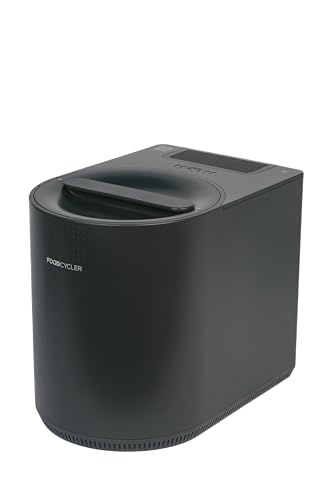
FoodCycler Eco 3
Check price on Amazon
Reencle Gravity
Check price on Amazon
The picks, by job
Four picks, one per job; the table further down lines up their specs.
1. FoodCycler Eco 5: our pick for a family's daily scraps
Our pick for a family's daily scraps
Best for: A family's daily food scraps
FoodCycler Eco 5
- Batch: Up to 5 liters
- Cycle: About 4 to 9 hours
- Energy: About 1.5 kWh a cycle
Dries and grinds up to 5 liters of scraps in about 4 to 9 hours, poultry and fish bones included; what comes out still needs composting or curing.
A countertop food recycler that dries, grinds and then cools a batch of up to 5 liters of scraps in about 4 to 9 hours, using about 1.5 kWh a cycle at a maximum of 500 W. It has a refillable charcoal filter. It is meant for households of four or more, or smaller ones with lots of food waste, and stands 13.8 inches tall, 13.5 wide and 10.9 deep, at 30 pounds.
Why it is our pick: The 5-liter bucket is the larger of the two dryers here, and it takes meat, fish and poultry, poultry and fish bones and shellfish, with dairy, pork and lamb bones and hard pits in small amounts.
Good to know: What comes out is a fine, dry by-product sold under the name Foodilizer: add it to a green bin or a compost haul, or mix it with compost. Refill the charcoal in the filter every three or four months on average. The cut in volume is advertised at up to 90%.
2. Reencle Prime: our pick for compost rather than dried scraps
Our pick for compost rather than dried scraps
Best for: Compost rather than dried scraps
Reencle Prime
- Daily: Up to 2.2 lb
- Compost: About 30 days
- Noise: Under 28 dB
Microbes break scraps down around the clock, up to 2.2 pounds a day, with compost in about 30 days.
A kitchen unit with a 14-liter chamber where a colony of microbes breaks scraps down around the clock. You add scraps any time, 1.5 pounds a day recommended and 2.2 pounds at most, through a lid that opens when you wave a foot at its sensor. It runs at under 28 dB and draws 52 W on average, 130 W at most. It is sized for 1 to 3 people, stands 18.4 inches tall, 13 wide and 12 deep, and weighs 20.1 pounds.
Why it is our pick: What it makes is billed as compost, not dried scraps: microbes ferment the scraps, the compost is done in about 30 days, and you harvest roughly every 1 to 3 months. It also takes meat, fish and dairy, which a backyard pile should not get.
Good to know: No bones of any size, large pits such as peach or avocado, hard shells, or excess liquid. The microbes renew themselves, so there is no refill on a schedule; the carbon filter is replaced every 9 to 12 months. A fresh pack of microbes needs about 18 to 24 hours to become active before the first scraps; then ramp up so the colony can adapt, with no more than 200 to 300 grams a day for the first three days.
3. FoodCycler Eco 3: our pick for a small household
Our pick for a small household
Best for: One to three people
FoodCycler Eco 3
- Batch: 3.5 liters
- Cycle: About 4 to 9 hours
- Energy: About 0.9 kWh a cycle
The smaller FoodCycler: a 3.5-liter bucket and about 0.9 kWh a cycle, sized for 1 to 3 people.
The smaller FoodCycler: the same drying and grinding with a 3.5-liter bucket, a cycle of about 4 to 9 hours and about 0.9 kWh a cycle. It stands 11 inches tall, 9 wide and 13 deep, and weighs about 22.5 pounds.
Why it is our pick: Sized for 1 to 3 people, or a larger family that throws out less food, its bucket holds 3.5 liters to the Eco 5's 5. In our arithmetic, 0.9 kWh is 40 percent less power a cycle than the Eco 5's 1.5.
Good to know: It takes the same scraps as the Eco 5, bones included, and the charcoal in its filter is refilled every three or four months on average. What comes out is the same dry by-product, which still needs composting or curing.
4. Reencle Gravity: our pick for a big household that wants compost
Our pick for a big household that wants compost
Best for: Three or more people who want compost
Reencle Gravity
- Daily: Up to 3.3 lb
- Compost: About 30 days
- Noise: Under 26 dB
The larger Reencle: up to 3.3 pounds of scraps a day at under 26 dB, with compost in about 30 days.
The larger Reencle: 2.2 pounds of scraps a day recommended and 3.3 pounds at most, at under 26 dB. It draws 47 W on average and 95 W at most, and stands 20.6 inches tall, 12.4 wide and 13.7 deep, at 24.9 pounds. The listing linked here comes with a Reencle Compost Starter 2.0 and a booster pack.
Why it is our pick: Its daily maximum is half again the Prime's, 3.3 pounds against 2.2. It is sized for households of 3 to 4 people, and its product page pitches it at families of 4 and more. Like the Prime, it is a microbe unit, with the same claim of compost in about 30 days.
Good to know: The same rules as the Prime: no bones, large pits, hard shells or excess liquid, a carbon filter every 9 to 12 months, and a harvest every 1 to 3 months. Its product page lists a built-in weight display.
How we chose these
This guide covers kitchen units that take food scraps indoors: dryers that grind and dehydrate them, and microbe units. We went through each maker's product pages, product data and manuals, and kept models whose maker lists the capacity, the cycle time or daily amount, and the power use. Each pick is sold on Amazon by its own maker. What these machines make, and how to use it, comes from the government and extension pages in the Sources list. Each of the four Amazon picks was new and in stock on Amazon on October 30, 2026. We read no independent test of what the four picks make, so each maker's word for its output is given as its own. We do not run growing trials or show star ratings.
Also considered
Reencle Essential. The same 2.2 pounds a day at most as the Prime, without the hands-free lid, at 27 dB and roughly 0.9 kWh a day; it is sized for 1 to 2 people, where the Prime covers 1 to 3.
Lomi 3. A dryer with a 3-liter bucket, an Express mode of 3 to 6 hours and a Grow mode of 11 to 17 hours, at under 45 dB; what comes out is called pre-compost. Our Amazon catalog search on October 30, 2026 turned up Lomi's pods and filters, not the machine.
Mill. It works overnight and can be filled for weeks; it is advertised as cutting food volume by 80%, and what comes out is called grounds. No Mill unit turned up in the same Amazon search.
Airthereal Revive R500. A 2.5-liter dryer that turns scraps into a dry powder; its product page lists no power use or noise level, so it could not join the spec table.
Spec by spec: the four machines side by side
| Pick | Works by | Capacity (maker's spec) | Time (maker's spec) | Power (maker's spec) | Noise (maker's spec) | Filter (maker's spec) | What comes out (maker's words) | kWh a year (our arithmetic) |
|---|---|---|---|---|---|---|---|---|
| 1. FoodCycler Eco 5 | Drying and grinding, by the batch | Up to 5 liters a cycle | About 4 to 9 hours a cycle | About 1.5 kWh a cycle; 500 W max | Not given | Charcoal refill every 3 or 4 months on average | "a fine, dry by-product" | About 548 at a cycle a day |
| 2. Reencle Prime | Microbes, around the clock | 1.5 lb a day; 2.2 lb max | Compost in about 30 days | 52 W average; 130 W max | Under 28 dB | Carbon filter every 9 to 12 months | "real, usable compost" | About 456 |
| 3. FoodCycler Eco 3 | Drying and grinding, by the batch | 3.5 liters a cycle | About 4 to 9 hours a cycle | About 0.9 kWh a cycle; 500 W max | Not given | Charcoal refill every 3 or 4 months on average | "a fine, dry by-product" | About 329 at a cycle a day |
| 4. Reencle Gravity | Microbes, around the clock | 2.2 lb a day; 3.3 lb max | Compost in about 30 days | 47 W average; 95 W max | Under 26 dB | Carbon filter every 9 to 12 months | "real, living compost" | About 412 |
For the FoodCyclers, the yearly figure assumes one cycle a day; a cycle every other day halves it, and each also uses about 0.5 kWh a month on standby. For the Reencles, which run all the time, it assumes the listed average draw around the clock. We measured nothing ourselves: the numbers come from the makers, plus our own arithmetic.
Do electric composters make compost?
The dryers do not. A countertop dryer grinds and dehydrates scraps into a dried food scraps mixture with about a third of the weight and bulk of what went in (the makers claim 80 percent less volume for the Mill and up to 90 percent for the FoodCycler Eco 5), but it is not compost. That mixture is not biologically stable: once it gets wet again it breaks down fast and can regain the odor of fresh scraps and draw pests such as flies. So compost it, cure it or treat it some other way before it feeds plants; curing often takes a few weeks.
Compost is what a well-kept pile makes in about three to five months: dark, crumbly and earthy-smelling. The dryers' makers use their own words for their output: FoodCycler a dry by-product, Lomi pre-compost and Mill grounds. The Reencles work differently, with microbes that ferment the scraps, and the result is sold as compost, ready in about 30 days.
How do you use what an electric composter makes?
Dried scraps from a dryer can go into a compost pile, a green bin or a food scraps collection program. They can also be dug into garden soil, where they break down; wait at least three weeks before planting. Amount matters: in one study, dried food scraps mixed into soil at 2% by weight helped corn and wheat grow, while 5% led to some plant toxicity.
Compost from a Reencle, its maker says, can go straight onto a garden, raised beds or houseplants.
What can go in an electric composter?
More than a backyard pile takes. Meat, fish, bones and dairy stay out of a backyard pile: they can attract animals, and home piles generally stay too cool to fully break them down. The FoodCyclers take meat, fish, poultry and shellfish, with poultry and fish bones, and take dairy, pork and lamb bones and hard pits in small amounts; they are not for cardboard, oils and fats, candy and gum, most compostable plastics or beef bones. The Reencles take meat, fish and dairy, but no bones of any size, large pits such as peach or avocado, hard shells or excess liquid.
How much electricity does an electric composter use?
A dryer uses power by the batch, a microbe unit all day. In our arithmetic, at one cycle a day, the Eco 3's 0.9 kWh comes to about 329 kWh a year and the Eco 5's 1.5 kWh to about 548. The Reencles run all the time: at their listed average draw, the Gravity's 47 W comes to about 412 kWh a year and the Prime's 52 W to about 456. A dryer run every other day uses half its figure.
Checklist: buying an electric composter
- Dryer or microbes: dried scraps in hours that still need composting or curing, or compost in about a month.
- Capacity: liters a batch for a dryer, pounds a day for a microbe unit, against what your kitchen throws out.
- Scraps: poultry and fish bones go in a FoodCycler, not a Reencle; meat and fish go in both, and dairy goes in a FoodCycler only in small amounts.
- Filter: charcoal every 3 or 4 months on average for the FoodCyclers, a carbon filter every 9 to 12 months for the Reencles.
- Power: by the cycle, or around the clock.
- Noise: under 26 to 28 dB for the Reencles; the FoodCycler pages give no decibel figure.
Related guides
- Compost bins and tumblers, for a backyard pile that turns scraps and leaves into compost.
- Building a raised garden bed, including the topsoil and compost mix to fill it.
- How to start a garden, from a soil test and compost to the first crops.
- Gifts for gardeners, including picks for someone who composts.
Frequently asked questions
Do electric composters really make compost?
The dryers do not. They grind and dehydrate scraps into a dried mixture that is not biologically stable and still needs composting, curing or other treatment before it feeds plants. Microbe units such as the Reencles ferment scraps with microbes into what is billed as compost, ready in about 30 days.
Which electric composter should I get?
Our pick for a family's daily food scraps is the FoodCycler Eco 5, which dries and grinds up to 5 liters in about 4 to 9 hours. For compost rather than dried scraps, the Reencle Prime; for one to three people, the FoodCycler Eco 3; for three or more who want compost, the Reencle Gravity.
Can you put meat and bones in an electric composter?
Meat, yes, in all four picks. The FoodCyclers take poultry and fish bones, with pork and lamb bones in small amounts, but not beef bones. The Reencles take meat, fish and dairy but no bones of any size. A backyard pile should get none of these.
Can I put electric composter output straight in the garden?
Not dried scraps fresh from a dryer. They are not biologically stable, so compost or cure them first, or dig them into the soil and wait at least three weeks before planting. Compost from a Reencle, its maker says, can go straight onto a garden, raised beds or houseplants.
How much electricity does an electric composter use?
In our arithmetic, from about 329 kWh a year (the FoodCycler Eco 3 at a cycle a day) to about 548 (the Eco 5 at a cycle a day). The Reencles, which run all the time, come to about 412 (Gravity) and 456 (Prime) at their listed average draw.
Are electric composters noisy?
The Reencles list under 28 dB for the Prime and under 26 dB for the Gravity. No decibel figure is listed for the FoodCyclers; the Eco 5 manual says most cycles are quiet and that noises during a cycle are normal.
Sources
- "FoodCycler: Eco 5"
- "FoodCycler: Eco 5 manual"
- "FoodCycler: Eco 3"
- "FoodCycler: Eco 3 manual"
- "FoodCycler: Which FoodCycler is right for you?"
- "Reencle: Reencle Prime"
- "Reencle: Reencle Gravity"
- "Reencle: Reencle Essential"
- "Reencle: ReencleMicrobe Compost Starter"
- "Lomi: Lomi 3 Food Recycler"
- "Mill: the food recycler"
- "Airthereal: Revive R500 Electric Kitchen Composter"
- "US EPA: Composting at home"
- "US EPA: Approaches to composting"
- "US EPA: Emerging issues in food waste management, commercial pre-processing technologies (2021)"
- "University of California Agriculture and Natural Resources: Dehydrated food scraps as soil amendments"