
How to Grow Tomatoes in Pots: Pot Size, Varieties and Care
Grow a compact determinate or patio tomato in a pot of at least 5 gallons, or a full-size one in 8 to 10 gallons or more. Fill it with potting mix, give it 6 to 8 hours of sun, water whenever the top inch or two of mix is dry, often daily, and feed on a schedule.
Sources: UNH Extension, Penn State Extension, University of Maryland Extension, Virginia Cooperative Extension 426-336 and 7 more. See the sources we used. How we source our guides

On this page (12)
As an Amazon Associate we earn from qualifying purchases.
Grow a compact determinate or patio tomato in a pot that holds 5 gallons or more, and a full-size one in 8 to 10 gallons or more, though the minimums given for a full-size tomato run from 5 gallons up to a whiskey barrel. Fill the pot with potting mix, put it where direct sun reaches it for at least 6 to 8 hours each day, and water whenever the top inch or two of mix is dry, which in hot weather often means once a day or more.
For a fabric pot in those sizes, see the best grow bags, from 5 gallon bags for patio varieties to a larger planter for one tomato plant.
A pot changes the job: the roots can only use the nutrients in the pot, the mix can dry out quickly, and watering washes nutrients out. This page pools the container advice of 11 university extension services and, where they disagree on a number or a step, sets out the spread. For seed starting, planting dates and picking, see our main tomato guide.
| Pot size | About 2 to 6 gallons for a compact tomato, as little as 1 for a cherry type; 8 to 10 gallons or more for a full-size one, though minimums run from 5 gallons up to a whiskey barrel |
|---|---|
| Pot width | From a 14 to 20 inch pot for most compact types to at least 20 inches across for any one plant |
| Varieties | Patio, balcony or bush in the name, or bush or determinate on the packet |
| Potting mix | A bagged mix, never plain garden soil: a soilless mix in four guides, or a good packaged potting soil, which may do |
| Sun | Direct sun for at least 6 to 8 hours; fruiting crops do better with 8 to 10 |
| Water | When the top 1 to 2 inches of mix is dry; in summer, at least daily and possibly twice |
| Feeding | Slow-release at planting, then soluble fertilizer anywhere from weekly to every 2 to 4 weeks |
| Support | Usually needed: a cage or stake at planting, at least for plants that grow past 2 feet |
What size pot do tomatoes need?
A compact tomato needs a pot of about 2 to 6 gallons, and a cherry type can go in one as small as 1 gallon. For a full-size tomato, minimums run from 5 gallons through 8 to 10 gallons or more, up to a container as big as a whiskey barrel for a standard garden type.
| Measure | Compact or determinate | Full-size or indeterminate |
|---|---|---|
| Mix volume | 2 to 6 gallons: 2 to 5 by plant size, at least 4 to 6 for a dwarf type, and 4 to 5 usually enough; as little as 1 gallon for a cherry tomato | 5 gallons; at least 8 to 10 gallons, one plant per pot; or about whiskey barrel size, with a trellis |
| A 5-gallon bucket | Works once it has drainage holes; a 5-gallon nursery pot is one example of a pot 12 inches deep | Too small for a plant that keeps growing all season, or a good size once it has drainage holes |
| Depth | 8 to 12 inches deep, or 12 inches or more | 12 to 16 inches deep |
| Pot size in inches | A 14 to 20 inch pot for most compact cultivars | Not given |
| One size for every tomato | At least 20 inches wide, and as tall as it is wide; at least 20 inches across the top; or tall enough for 16 to 20 inches of mix | The same |
| Growing it in a pot | Grows well in a container | Can grow in a pot but can be harder to keep healthy; hard to grow in a pot; or any cultivar can, and a bigger pot holds growth back less |
Each cell collects the figures the guides give; where a cell lists several, they come from different guides.
A pot 20 inches wide holds far more than the smallest figures. A soil-volume table lists 15 gallons for an 18-inch pot and 25 gallons for a 24-inch pot, so a 20-inch pot falls between the two: three times or more the 4 to 5 gallons also given as usually enough for one plant.
Bigger is easier. A larger container makes the crop easier to care for, more mix can hold more moisture, and too small a pot means constant watering and a plant that may blow over. Our reading: give a compact variety at least 5 gallons and a vining one 8 to 10 gallons or more.
What you'll need for tomatoes
Picks on Amazon
- Rain Bird HET200 2-Station Hose End Timer Check price on Amazon
- Smart Pot Fabric Planter, 20 Gallon Check price on Amazon
- VIVOSUN Grow Bags, 10 Gallon, 5-Pack Check price on Amazon
- Burpee Pro Series Tomato Cage, 48 Inch, 3-Pack Check price on Amazon
Which tomato varieties grow well in pots?
Choose a determinate, bush or patio variety and check the mature height on its label, since not every determinate stays compact. Look for patio, balcony or bush in the name, or for bush or determinate, often printed on the seed packet.
Determinate tomatoes. Their shoots end in flower clusters, so they tend to stay fairly short, 3 to 4 feet, and bushy, and grow well in containers. The fruit tends to ripen over a short period, usually a couple of weeks, and within four to six weeks the whole crop can be picked.
Indeterminate tomatoes. These keep growing and flowering until frost, which makes them the harder choice for a pot. Advice on them runs from raising any cultivar in a container to saying a bush type may be the only option there. In between, indeterminates can be grown in containers but can be harder to manage and keep healthy, and Brandywine, Better Boy, Cherokee Purple, Early Girl and Rutgers are named as difficult in a pot because they keep growing taller until frost. The smaller determinates are ideal, since they take longer to outgrow the pot and are easier to trellis.
Patio types, with their small vines, may be trellised or grown in hanging baskets.
| Variety | What the guides say |
|---|---|
| Patio Choice Yellow | Compact, about 18 inches tall, yellow cherry fruit |
| Tumbler | Mounded habit for hanging baskets, red cherry-size fruit |
| Bush Early Girl | Stays under 3 feet; round red fruit up to 4 inches across |
| Tiny Tim | About 12 to 15 inches tall; suggested for pots indoors, and on a list of determinate patio types |
| Small Fry | About 3 feet tall; suggested for pots indoors, and on a container list |
| BushSteak, Celebrity, Tumbling Tom | Determinate patio or container types |
| Micro Tom, Kitchen Minis | Container varieties |
| Gold Nugget, Siletz, Legend | On a container list, and determinate |
Choosing a pot: drainage, material and grow bags
Whatever you choose needs holes in the bottom. Good drainage counts for more than what the container is made of, and every container except a self-watering one needs bottom holes or slits. If a bucket has none, drill holes in the bottom, or along the sides 1/4 to 1/2 inch up from the base.
- Plastic, clay or fabric. Plastic is light and dries out more slowly than terracotta. Clay, ceramic, concrete and wood are porous and dry faster than plastic or metal, and so does fabric.
- Color and heat. Dark and metal pots absorb heat that can damage plants, and dark ones could injure young roots. In full sun, a pot raised off the ground may get too hot; if it does, consider setting it on the ground or where it gets shade in the hottest hours.
- Weight and wind. Light plastic, resin and fiberglass pots can tip under a big, top-heavy plant; a heavy cement or stone pot can help keep one upright.
- Grow bags. Grow bags are a suitable container. They are light and portable and even out soil temperature, and since excess water leaves through the fabric, one guide says they cannot be overwatered.
- Pots with a reservoir. If you cannot water daily, or sometimes twice a day, use a pot with a water reservoir; in a large pot, drainage holes a few inches up the sides leave water below for the roots.
- No gravel layer. Rocks or broken pots in the base do not improve drainage; they may push the water table up, which can cause drainage problems. Set the pot on pot feet or a brick instead.
What potting mix to use for tomatoes in pots
Use a bagged potting mix, not plain garden soil. Four of the guides call for a soilless mix: soil and mixes based on it are typically dense and heavy and can keep a pot from draining, garden soil compacts and still drains poorly, and it may carry weed seeds or disease.
Advice splits here: soilless mixes such as peat-lite are also called generally too light to hold vegetable roots, so a light container can blow over, and on that view a good packaged potting soil may make a good container medium. To mix your own for a large container garden, combine equal parts peat moss, garden loam and coarse sand or perlite with a slow-release 14-14-14 fertilizer. If you do use garden soil, add equal parts of peat moss and of perlite or coarse sand.
Compost. Finished compost can go into the mix: advice runs from up to 50 percent of a soilless mix to a major part of it, or all of it if the compost drains well. A larger pot with more than 25 percent compost likely needs no extra fertilizer. With no yard for a pile, see the best kitchen composters; of those, the two Reencles make compost from kitchen scraps, and the FoodCycler dryers make a dried mix that still has to be composted or cured.
Lime. Advice splits: add garden lime, about 1 cup for a 5-gallon container, so the plant has enough calcium, or never add lime, wood ash or gypsum to a commercial mix, because commercial soilless mixes already contain it.
Filling and reuse. Leave 1 to 2 inches between the mix and the rim. When you reuse mix, clear the old plant debris out of it, and after a year of severe disease, strongly consider starting over with new mix.
How often to water tomatoes in pots
Check each pot at least once a day and water when the mix is dry near the surface, in the top 1 to 2 inches. In hot summer months, most container gardens need watering at least daily, and established plants may need it twice a day.
- Water until it drains. Keep pouring until water runs from the drainage holes. One long watering does far more than several shallow ones.
- Feel first. Push a finger into the mix; if it feels dry, water. Keep the mix moist but never waterlogged; pots kept too wet in cool weather may get root rot.
- Water the base. Water the mix, not the leaves, to help hold off disease, and empty saucers after watering.
Pots on sunny concrete can dry out very quickly. Group them so the leaves shade the mix, and consider pallets for air underneath. House walls can make a patio up to ten degrees warmer than the air around it.
A drip system on a timer can reduce upkeep and keep plants from drying out completely in the heat of the day, and if you are often away, automatic drip emitters are worth considering. Run two or more emitter lines per plant in case one clogs.
Blossom end rot. This disorder, a patch at the fruit's end that turns brown, then black, comes from too little calcium in the mix or from inconsistent watering, which is very common with container tomatoes, and roma types are much more prone to it than small, round fruit. A mix that cannot store enough water is another cause.
How often to fertilize tomatoes in pots
Mix a slow-release fertilizer in at planting, then feed with a water-soluble fertilizer on a schedule, anywhere from once a week to every 2 to 4 weeks. A potted tomato needs more feeding than one in a bed.
| Stage | What the guides use | How often |
|---|---|---|
| At planting | Timed-release or slow-release fertilizer, such as pellets mixed into the mix; check the mix label first, and note that a mix with fertilizer added lasts 8 to 10 weeks | Once, per the package |
| After that | Soluble fertilizer when you water, or more timed-release pellets as the package directs | Once a week, from two weeks after planting; a light feeding every 2 weeks, which tomatoes may need; every 2 to 3 weeks; or every 2 to 4 weeks |
| Only if needed | Slow-release or liquid fertilizer, per the label | Likely none in a larger pot with more than 25 percent compost |
Where a cell lists several, they come from different guides.
For the kind, advice runs from a balanced fertilizer to one whose middle number (phosphorus) is higher than its first (nitrogen), such as a tomato fertilizer or one of the complete grades 4-12-4, 5-10-5 and 5-10-10. Tomatoes respond well to phosphorus in particular.
More is not better. Too much fertilizer can burn the plant and leave excess salt in the mix, and a pot lacks the large volume of soil that buffers a bed against too much fertilizer or lime.
Staking and caging a tomato in a pot
Set a cage or other support at planting for any variety that grows taller than 2 feet, and put supports in while plants are still small, so roots are not damaged later. Potted tomatoes usually need support, since the plant and its fruit can grow heavy enough to bend and break, and even compact tomatoes may still need one.
- Cage size. Match the cage to the plant, with openings large enough to pick fruit through. Advice splits on small cages: a conical wire cage with two rings works with most containers, but the short, narrow cages often sold at garden centers are all but useless for anything except the smallest dwarf types. For cages matched to tall, bush and pepper plants, see the best tomato cages.
- Airflow. A cage can trap humid air in the plant's center, where it can encourage fungal disease. It can help to space the pots apart and prune to three or four stems.
- Pruning. Dwarf container tomatoes are not suited to pruning, apart from the Husky hybrids. For vining plants, see our guide to pruning tomatoes.
Where to put a tomato pot
Put the pot in full sun, within reach for watering and picking. Give it direct sun for at least 6 to 8 hours a day: fruiting vegetables generally need at least six hours and do better with eight to ten.
Plant when you would plant a garden bed. Tomatoes are cold-sensitive, so watch your area's frost-free date; our frost dates page gives it by location. Tomatoes need nights above 55 F for the pollen to develop. Move pots to shelter in storms and early fall frosts.
Pots, cages and supplies for tomatoes
You need a pot with drainage holes, potting mix, a slow-release and a soluble fertilizer, a cage, and, if you are often away, a drip line on a timer. The timer, the grow bags and the cage are on Amazon.

Our pick for one full-size tomato
Best for: A vining or large tomato on a patio or deck
Smart Pot Fabric Planter, 20 Gallon
- Size: 20 inches wide, 15.5 inches tall
- Soil: About 2.8 cubic feet
- Fabric: BPA- and lead-free, per the maker
A fabric pot 20 inches wide, the width two guides set for one tomato; the maker says it drains by design.

Our pick for a row of patio tomatoes
Best for: Compact determinate or patio varieties
VIVOSUN Grow Bags, 10 Gallon, 5-Pack
- Size: 15.9 by 15.9 by 11.9 inches
- Count: Five bags
- Fabric: 300g polyester nonwoven, BPA-free, per the maker
Five 10-gallon bags with sewn-on handles, each above the 2 to 6 gallons the guides give a compact tomato.
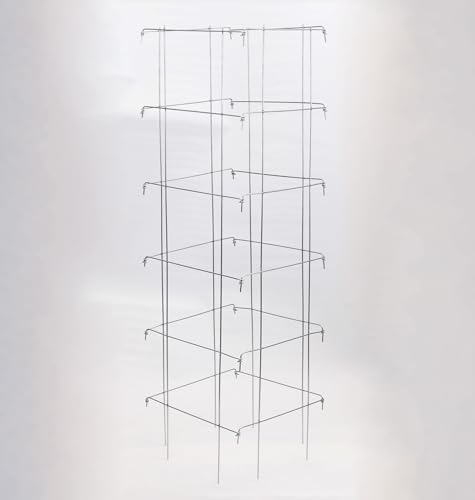
Our pick for a determinate tomato in a 20 inch pot
Best for: A determinate or patio plant in a pot about 20 inches across
Burpee Pro Series Tomato Cage, 48 Inch, 3-Pack
- Height: 48 inches overall
- Frame: 14 by 14 inches, 10-gauge wire
- Count: 3 cages, eight 8-inch prongs each
A folding 10-gauge square cage with 8 by 8 inch openings to pick through; about 20 inches corner to corner, so it suits the 20 gallon pot, not the bags.
One full-size tomato. The Smart Pot 20 gallon fabric planter is 20 inches wide, the width two guides set for one tomato, and 15.5 inches tall, about 2.8 cubic feet of mix; the maker says it drains by design. Being wider than tall, it falls short of a pot at least as tall as it is wide, and of 16 to 20 inches of mix.
A row of patio types. The VIVOSUN 10 gallon bags come five to a pack, each 15.9 by 15.9 by 11.9 inches, in 300g polyester fabric with sewn-on handles: well over the 2 to 6 gallons the guides give a compact tomato.
A cage for a determinate or patio plant. Burpee's Pro Series cages come 3 to a pack, 48 inches overall on a 14 by 14 inch frame of 10-gauge wire, with 8 by 8 inch openings and eight 8-inch prongs, and fold flat. That square measures about 20 inches corner to corner, so it needs a pot about 20 inches across, such as the Smart Pot above, and is too wide for the 15.9-inch bags. For a smaller pot, use a conical two-ring cage, the kind that works with most containers.
A timer at the tap. The Rain Bird HET200 is a 2-station hose end timer, and the maker names drip lines among its uses. Each station keeps its own schedule, set to chosen days of the week or an interval of 1 hour to 14 days, with a run time of 1 minute up to 6 hours. It runs on 2 AAA batteries, not included.
Sources we used
All figures come from the pages below, each saved when we read it; the pot volume comparison is worked out from the soil-volume table, and product details are the makers' own.
- "UNH Extension: What is the best way to grow tomatoes in a container?" (2020)
- "Penn State Extension: Container Vegetable Gardening, Four Keys to Success" (updated March 30, 2026)
- "University of Maryland Extension: Types of Containers for Growing Vegetables" and "Maintaining Container Grown Vegetables" (both updated February 20, 2023)
- "Virginia Cooperative Extension 426-336: Vegetable Gardening in Containers" (revised March 2026)
- "Clemson Extension HGIC: Tomatoes in Containers"
- "Oregon State University Extension EC 1333: Grow your own tomatoes and tomatillos" (reviewed 2024)
- "Colorado State University Extension: Vegetable Gardening in Containers"
- "Illinois Extension: How to Grow Fruits, Vegetables, Herbs in Container Gardens" (2022) and "Home Vegetable Gardening: Tomato"
- "UW-Extension Marinette County: Growing a Tomato Plant in a Container"
- "UC Master Gardener Program of Contra Costa County: Great Patio Container Tomatoes and Peppers"
- "University of Minnesota Extension: Growing tomatoes in home gardens"
Related guides
- How to grow tomatoes, sowing to picking
- How to prune tomatoes, suckers and stems on vining plants
- How to grow peppers
- Nightshade family vegetables
- Companion planting chart
- How to grow eggplant, with pot sizes for one plant
Frequently asked questions
What size pot do tomatoes need?
Give a compact or dwarf tomato a pot of about 2 to 6 gallons, and a full-size one 8 to 10 gallons or more; the minimums for a full-size plant run from 5 gallons up to a whiskey barrel. By width, advice runs from a 14 to 20 inch pot for most compact types to at least 20 inches across for any one plant, and a pot 20 inches across holds well over 5 gallons.
Can you grow tomatoes in a 5-gallon bucket?
Yes, for a compact variety. A five-gallon plastic bucket is a good size once it has drainage holes, and a determinate plant fits in one. For a vining indeterminate, advice runs from a 5-gallon minimum to something bigger than a bucket: 8 to 10 gallons or more, or a container like a whiskey barrel.
What tomatoes grow well in pots?
Determinate, bush and patio varieties, which tend to stay short; check the label height. Container picks in the guides include Patio Choice Yellow, Tumbler, Bush Early Girl, BushSteak, Celebrity, Tumbling Tom and Tiny Tim. Any cultivar can be raised in a pot, but indeterminates such as Better Boy and Brandywine keep growing taller until frost, which makes them difficult in one.
How often should you water tomatoes in pots?
Check daily, and water whenever the top inch or two of mix feels dry. In hot weather, container tomatoes need a thorough watering daily, sometimes twice. Water slowly until it drains out the bottom, and aim at the mix, not the leaves.
Can I use garden soil for tomatoes in pots?
Not on its own. Four of the guides call for a soilless potting mix, because garden soil packs down and drains poorly in a pot; advice splits on light peat-lite mixes, and a good packaged potting soil may also do. If you do use garden soil, mix it one to one to one with peat moss and perlite or coarse sand.
How often should you fertilize tomatoes in pots?
Start with a slow-release fertilizer in the mix at planting. After that, feed a soluble fertilizer anywhere from once a week to every 2 to 4 weeks; tomatoes may need a light feeding every 2 weeks. Follow the label rate, since overfeeding can burn the plant.
Do tomatoes in pots need a cage?
Usually, yes: potted tomatoes usually need support, and a cage goes in at planting for any variety that grows past 2 feet. A two-ring conical wire cage works with most containers, but the short, narrow cages common at garden centers suit only the smallest dwarf types, so match the cage to the plant.
Are grow bags good for tomatoes?
They work. Grow bags are a suitable container: light, portable, and they drain excess water through the fabric. Fabric dries out faster than plastic, so check a bag daily in summer.