
Best Propagation Stations (2026): 5 Picks
Five propagation stations: a stand, loose vases, two for the window, one for your own jar.
As an Amazon Associate we earn from qualifying purchases. Some links are paid.
The best propagation station overall is the Kate Aspen Test Tube Flower Vase Propagation Station: three glass test tubes in a gold metal stand, each 4.75 inches tall, and any one lifts out on its own.
Top picks

Best overall: test tubes on a stand
1. Kate Aspen Test Tube Flower Vase Propagation Station
Three glass tubes in a gold metal stand; each lifts out.

For more cuttings at once
2. Glasseam Mushroom Glass Planter Vase
Five loose borosilicate glass vases, one stem to each.
For a window with no sill
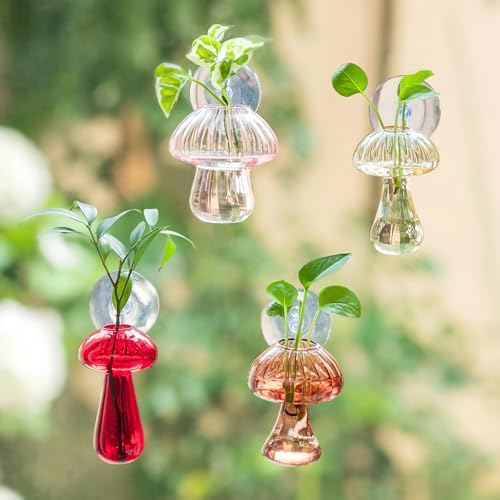
3. Glasseam Set of 4 Cute Mushroom Glass Vases
Four colored glass vases, each on its own suction cup.
| Pick | Where it goes | Cuttings | Opening | Where to buy |
|---|---|---|---|---|
| 1. Kate Aspen Test Tube Station | Desk or shelf stand | 3 | 0.9 in | Check price on Amazon |
| 2. Glasseam Mushroom Planter Vase | Loose, sill or shelf | 5 | 0.78 in | Check price on Amazon |
| 3. Glasseam Set of 4 | Window, own cups | 4 | 0.78 to 1.26 in | Check price on Amazon |
| 4. Sweet Feeders Lily | Window, copper frame | 3 | Not given | Check price on Amazon |
| 5. Peleg Leafriend | Your own glass | 3 | Your glass's | Check price on Amazon |


Sources: Kate Aspen, Glasseam, Sweet Feeders, Peleg Design and 4 more. See the sources we used. How we source our guides

On this page (11)
A propagation station holds plant cuttings in water so you can watch the roots form. The ones below differ in three ways: where they go (a stand on a desk, loose vases on a sill, the window glass itself, or a jar you already own), how many cuttings they take, and how wide the glass is at the top. Four of the five bring their own glass; the fifth turns a glass from your cupboard into a station.
How we chose these: every size, count and material below comes from the station's maker.
Start here: match the station to the spot and the cuttings
- Three cuttings on a desk or shelf, tubes that lift out: Kate Aspen Test Tube Flower Vase Propagation Station (pick 1).
- Five cuttings at once, one stem to a vase, on a sill or shelf: Glasseam Mushroom Glass Planter Vase (pick 2).
- No sill to spare, each glass on its own suction cup: Glasseam Set of 4 Cute Mushroom Glass Vases (pick 3).
- One handmade copper piece on the window, three stems: Sweet Feeders Lily Window Vase Propagator (pick 4).
- A jar, vase or drinking glass you already own: Peleg Design Leafriend (pick 5).
- A small gift for someone who roots pothos on the windowsill: Kate Aspen Test Tube Flower Vase Propagation Station (pick 1).
Going by each maker's list price, the test tube stand and the Leafriend are the budget picks, the copper window piece is the premium pick, and the two mushroom vase sets sit in between.
Five propagation stations, each for a different spot
Each card gives a station's parts and sizes as its maker states them, and a table comparing all five follows the last card.
1. Kate Aspen Test Tube Flower Vase Propagation Station: our pick for a desk or shelf
Best for: Three cuttings on a desk, shelf or sill Price class: budget pick
- Tubes: 3, each 4.75 in tall
Three glass test tubes set at varying heights in an angular holder of antique gold metal, 5.5 inches wide, 7.8 inches tall and 3.8 inches deep. Each tube is 4.75 inches tall and holds about 1.75 ounces of water. The opening is 0.9 inch across inside, 1.4 inches across the outer rim.
Why it made the list: Its maker gives every size a buyer needs, down to the inside of the tube, and the tubes work together or one at a time, so any one can come out to be rinsed and refilled while the others stay put. You can watch the roots form through the glass.
Before you order: The holder needs assembly. Each tube holds about 1.75 ounces of water, so check the level between changes. Its maker sells it as a centerpiece and as shelf or sill decor, so it is made to be seen, not tucked away.
2. Glasseam Mushroom Glass Planter Vase: our pick for more cuttings at once
Best for: Five single stems on a sill or shelf Price class: mid-range
Five small vases of handmade, thick borosilicate glass in mixed mushroom shapes, sizes and colors, each with one opening 0.78 inch across. The maker also sells the same vases as a set of ten; this pick is the set of five.
Why it made the list: Five vases means five cuttings started side by side, one stem to a vase, and nothing holds them in a row, so they fit a sill as well as a shelf. Each vase has one wider hole in place of the four small holes of the maker's older design, and a base made wider than a usual mushroom vase so it stands steady.
Before you order: The maker gives no height or width for the vases. At 0.78 inch the opening suits a single stem. The vases come in mixed colors.
3. Glasseam Set of 4 Cute Mushroom Glass Vases: our pick for a window with no sill
Best for: Cuttings hung on the window glass, spaced as you like Price class: mid-range
Four mushroom-shaped glass vases in red, pink, amber and yellow, each hanging from its own suction cup about 2 inches (5 cm) across. The vases stand 3.22 to 3.9 inches tall, with openings of 0.78 to 1.26 inches. The cups hold on smooth, non-porous surfaces such as windows and mirrors.
Why it made the list: When the sill is full or there is none, the vases go on the glass itself, and because each has its own cup you can space them along the pane as you like. The glass is transparent, so you can follow the roots as they grow.
Before you order: The four vases differ in size, so give the thickest stem the widest opening. A suction cup needs a smooth, non-porous surface such as glass or a mirror. Hang them where the light is bright but not direct sun.
4. Sweet Feeders Lily Window Vase Propagator: our pick for a handmade copper piece
Best for: Three cuttings in one frame on the window Price class: premium
A handmade copper frame that holds three stems in clear glass tubes and mounts straight onto a window with suction cups. The plant is not included. The maker says its glass can go in the dishwasher.
Why it made the list: It does the window job as one piece rather than four, with the three tubes held in a single copper frame, and each piece is made by hand. Being able to wash the tubes in the dishwasher matters on a station whose water you change every few days.
Before you order: The maker lists no dimensions for the frame or the tubes. By its list price it is the premium pick here. Like pick 3, it goes on the glass itself, so choose a pane out of direct sun.
5. Peleg Design Leafriend: our pick for a jar or glass you already own
Best for: A clean jar, bud vase or glass from the cupboard Price class: budget pick
- Container: Not included: use your own
Three small holders made of TPR, each 6.6 by 3.5 by 2.3 cm (about 2.6 by 1.4 by 0.9 inches), that sit on the side of a pot or vase and hold a cutting, a flower or an avocado stem. There is no container in the box.
Why it made the list: Most of a propagation station is the glass, and many kitchens already have one: a jam jar, a bud vase, a tumbler. The Leafriend turns any of them into a station: it sits on the rim and holds the cutting.
Before you order: You supply the container, and it should be clean. Clear glass lets you watch the roots.
How we chose these
We started from what a propagation station is: a holder that keeps a cutting in water where you can see it root. We looked through dozens of stations in Amazon's catalog and kept one only if its maker states the parts, count or size on the maker's own site; every pick here was checked line by line against that maker page. The final five cover one spot each (a stand, loose vases, the window glass, your own jar) and, for the window, one set of separate vases and one framed piece.
We left out stations whose makers publish no specs we could check, one set we could not tie to a single maker product, and the ten-vase version of pick 2, above this page's price range. The test tube stand ranks first because its maker gives every size from the stand down to the inside of the tube, its tubes lift out one at a time for a water change, and the stand keeps three cuttings upright on a table, shelf or sill. We did not root cuttings in these stations ourselves.
Our editorial policy says how we find, check and number the picks in every buying guide.
The five stations side by side
| Pick | Where it goes (maker's spec) | Cuttings (maker's spec) | Vessel (maker's spec) | Opening (maker's spec) | Size (maker's spec) | Holder (maker's spec) |
|---|---|---|---|---|---|---|
| 1. Kate Aspen Test Tube Flower Vase Propagation Station | Tabletop, shelf or windowsill | 3 tubes at varying heights | Glass test tubes, 4.75 in tall, about 1.75 oz each | 0.9 in inside, 1.4 in at the rim | 5.5 x 7.8 x 3.8 in | Antique gold metal; assembly required |
| 2. Glasseam Mushroom Glass Planter Vase | Loose vases for a sill or shelf | 5 vases | Handmade thick borosilicate glass, mixed shapes and colors | 0.78 in, one hole | Not given | None; wider base |
| 3. Glasseam Set of 4 Cute Mushroom Glass Vases | Windows and mirrors | 4 vases | Glass in red, pink, amber and yellow | 0.78 to 1.26 in, by vase | Each 3.22 to 3.9 in tall | A 2 in (5 cm) suction cup on each vase |
| 4. Sweet Feeders Lily Window Vase Propagator | Window, by suction cup | 3 stems | Clear glass tubes; dishwasher-washable | Not given | Not given | Handmade copper frame |
| 5. Peleg Design Leafriend | The side of your own pot or vase | 3 holders | None: use your own | Your container's | 6.6 x 3.5 x 2.3 cm per holder | TPR |
Which cuttings root in water
Plenty of houseplants root in a glass of water. Coleus roots in water most readily of all, and pothos, philodendron, arrowhead vine (nephthytis), Chinese evergreen, impatiens and wandering jew all root in water as well. Spring and early summer give philodendron its quickest rooting and are usually the most successful season for pothos.
Some plants do not take to it. Woody cuttings, citrus and hibiscus among them, tend to rot in a glass of water, so give those a rooting mix instead. A Monstera cutting will root in plain water, but only if the piece carries a node, where a leaf joins the stem; a leaf on its own will not grow and will rot in the end.
Water rooting has one real drawback, and some horticulturists advise a rooting mix instead because of it: roots that form in water are often weaker, and they settle into potting mix less readily than roots grown in a solid rooting mix. That is why the move to soil, below, needs care.
Taking a cutting for the station
Use sharp, clean tools: dip the blade in alcohol before and between cuts. Choose a healthy shoot and, for most plants, cut a piece 3 to 6 inches long, just below a node. Then take off the lower leaves (the bottom two to four, or the lower half of the cutting) and any flowers or buds, and set the stem in the water.
Take a few more cuttings than you need: the odds are better that one roots and grows into a plant. Early spring, March through April, is the best time to propagate houseplants, though it can be done all year. One check before you cut: many plants are patented, and propagating a patented plant is against the law even for your own use.
Water, light and cleaning
Water. Swap the water for fresh every 3 to 5 days, and sooner if it turns cloudy. A rooting hormone can be added straight to the water to encourage new roots; plants that root readily, such as coleus, do without it.
Light. Bright, indirect light: near a window, out of direct sun. A Monstera cutting does well by a north- or east-facing window and away from rooms with direct south or west sun. That matters most for the two window picks, which sit right on the glass: choose a pane that does not take the full afternoon sun.
Cleaning. Almost any jar or glass will root a cutting if it is clean and disease-free. Between batches, wash the glass, give it a bleach rinse (1 part chlorine bleach, 9 parts water), then rinse it well in clean water.
How long. It varies widely: some plants root within days, others take several weeks, and a Monstera cutting takes about 2 to 4 weeks.
Moving rooted cuttings into soil
Pot a cutting up once its roots are at least 1 inch long. Use a potting mix made for houseplants, in a container with a drainage hole, and do not wait too long to move each one into its own pot. Healthy roots are creamy white and firm; brown, soft roots mean too much water or a pot that does not drain.
The move to soil is the most critical step, because the cutting leaves moist, humid air for drier soil and less humidity. Watch the young plants closely for the first few weeks. Once a cutting has settled into its pot, feed it a soluble houseplant fertilizer as the label directs: once a month, or every two weeks while it grows fast, normally in spring and summer.
Related guides
- Pothos care, for the plant once its rooted cuttings are in pots.
- Wandering jew plant, a houseplant that roots readily in a glass of water.
- Low light houseplants, if the cuttings are bound for a dim room.
- Gifts for plant lovers, for grow lights, a watering can and other gifts for someone with houseplants.
Frequently asked questions
What is the best propagation station?
For most people, the Kate Aspen Test Tube Flower Vase Propagation Station: three glass tubes in a gold metal stand, each tube 4.75 inches tall with a 0.9-inch opening, and each lifts out for a water change. For five cuttings at once, see pick 2; for a window, picks 3 and 4.
Is it better to root cuttings in water or in soil?
Water lets you watch the roots and takes little space, but roots formed in water are often weaker and take to potting mix less readily than roots from a solid rooting mix. Woody cuttings such as citrus or hibiscus tend to rot there, so root those in a mix.
How often does a propagation station need fresh water?
Every 3 to 5 days, and sooner whenever the water turns cloudy.
Which plants can you root in water?
Coleus, pothos, philodendron, arrowhead vine, Chinese evergreen, impatiens and wandering jew all root in water. A Monstera cutting will too, as long as it includes a node.
When should a cutting move from water to soil?
When its roots are at least 1 inch long. Pot it in a houseplant mix with drainage and watch it closely for the first few weeks, since the move to drier conditions is the most critical step.
Can a propagation station go on a window?
Yes: picks 3 and 4 mount on the glass with suction cups, which need a smooth, non-porous surface. Keep cuttings in bright, indirect light rather than direct sun.
Is it legal to propagate any houseplant from a cutting?
Not always. Many plants are patented, and propagating a patented plant is against the law even for your own use, so check a named variety before you root it.
Sources
- "Kate Aspen: Test Tube Flower Vase Propagation Station"
- "Glasseam: Mushroom Glass Planter Vase"
- "Glasseam: Set of 4 Cute Mushroom Glass Vases"
- "Sweet Feeders: The Lily Window Vase Propagator (Triple Stem)"
- "Peleg Design: Leafriend"
- "University of Missouri Extension: Home Propagation of Houseplants (G6560)"
- "University of Illinois Extension: Houseplants, Propagation"
- "University of Illinois Extension: From one to many: A beginner's guide to plant propagation"
- "University of Minnesota Extension: Propagating Monstera deliciosa"
- "University of Georgia Extension: Starting Plants From Cuttings for the Home Gardener (B1553)"