
Greenhouse Kits (2026): 5 Best Picks
Five walk-in kits, one per job: freestanding, cold winters, a garden room, a wall, most floor.
As an Amazon Associate we earn from qualifying purchases. Some links are paid.
The best freestanding greenhouse kit is the Palram Canopia Essence 8x12 Greenhouse, an aluminum walk-in with twin-wall polycarbonate panels and a galvanized steel base.
Top picks

Our pick for a freestanding greenhouse kit
1. Palram Canopia Essence 8x12 Greenhouse
A 12 by 8 foot aluminum walk-in with twin-wall polycarbonate panels.
Our pick for growing through a cold winter
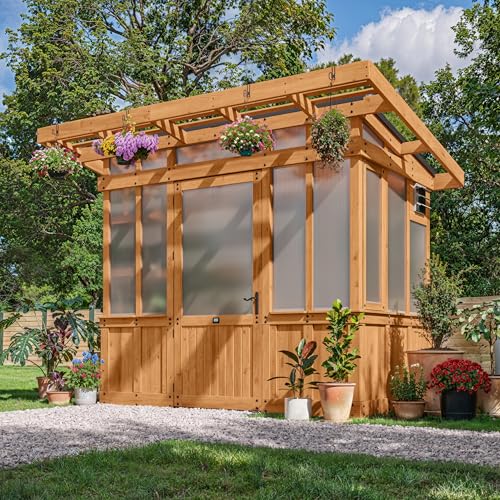
2. Backyard Discovery Poppy 9x6 Cedar Greenhouse
A cedar walk-in with 10 mm 4-wall polycarbonate panels.

Our pick for a hexagonal garden room
3. Palram Canopia Oasis 8 Hexagonal Greenhouse
A six-sided aluminum walk-in on a galvanized steel base.
| Pick | Size, build | Where to buy |
|---|---|---|
| 1. Palram Canopia Essence 8x12 | 12 ft x 8 ft; 4 mm twin-wall polycarbonate; aluminum frame | Check price on Amazon |
| 2. Backyard Discovery Poppy 9x6 | 9 x 6 ft nominal; 10 mm 4-wall polycarbonate; cedar frame | Check price on Amazon |
| 3. Palram Canopia Oasis 8 | Hexagonal, 6 ft 11 in x 8 ft; twin-wall polycarbonate roof; aluminum frame on a steel base | Check price on Amazon |
| 4. Outsunny 10x5 Lean-to | 118 x 59 in; PE cover; galvanized steel frame | Check price on Amazon |
| 5. Outsunny 13x10 Hoop House | 155.5 x 118.1 in; 140 gsm PE cover; steel tube frame | Check price on Amazon |


Sources: Canopia by Palram, Palram Canopia, Backyard Discovery, Outdoor Style Company and 5 more. See the sources we used. How we source our guides

On this page (13)
For a cold winter, the Backyard Discovery Poppy 9x6; for a hexagonal garden room, the Palram Canopia Oasis 8; against a wall, the Outsunny 10x5 Lean-to; for the most floor, the Outsunny 13x10 Hoop House. For a shelf unit, cold frame or pop-up, see our mini greenhouse guide.
How we chose these: sizes and panels above are the makers' own, or a retailer's copy of the lean-to's specs, and we did not build or grow in these kits ourselves.
Start here: which greenhouse kit for your yard
- A freestanding walk-in for the backyard: Palram Canopia Essence 8x12 Greenhouse (pick 1).
- Growing through a cold, snowy winter: Backyard Discovery Poppy 9x6 Cedar Greenhouse (pick 2).
- A hexagonal garden room, steel base included: Palram Canopia Oasis 8 Hexagonal Greenhouse (pick 3).
- Against a wall of the house, garage, barn or shed: Outsunny 10x5 Lean-to Greenhouse (pick 4).
- The most floor, for beds in the ground: Outsunny 13x10 Hoop House Greenhouse (pick 5).
The picks, by job
Sizes, panels and limits below come from each kit's maker; where we converted units or worked out a floor area, the text says so. The lean-to's come from a retailer's copy of its maker's specs.
1. Palram Canopia Essence 8x12 Greenhouse: our pick for a freestanding greenhouse kit
Best for: A freestanding walk-in for the backyard
An aluminum walk-in, 367 by 244 cm (12 by 8 feet) and 229 cm (7 feet 6 inches) tall, with 4 mm twin-wall polycarbonate roof and wall panels, a galvanized steel base, two manual vent windows and a built-in gutter.
Why this one: At about 96 square feet, worked out from its maker's size, it has the most floor of the three rigid kits here and meets the suggested minimums below. It is built for garden work: lockable double doors with a low threshold ramp take a wheelbarrow. Its manual puts assembly at two people and at least half a day.
Good to know: The base is in the box, but no floor, ground stakes or foundation fasteners are; its manual says to secure it directly to a solid foundation, and an anchoring kit is sold separately. Its declaration of performance sets the limits for the 8-foot series at 0.50 kN per square meter of snow (about 10.4 pounds per square foot) and 21 meters per second of wind (about 47 mph), by our conversion; its product page says it was tested to hold up to 56 mph of wind and 15 pounds per square foot of snow, with no basis given, so go by the lower figures. That page's door line says 47 by 75 inches; its dimension table, used here, says 3 feet 9 inches by 6 feet 4 inches.
2. Backyard Discovery Poppy 9x6 Cedar Greenhouse: our pick for growing through a cold winter
Best for: Growing through a cold, snowy winter Price class: premium
A cedar walk-in, 9 by 6 feet with 50 square feet inside, a trellis roof extending on three sides for baskets and vines outside, and a peak of 8 feet 6 1/4 inches. The panels are 10 mm 4-wall polycarbonate, the frame FSC-certified kiln-dried cedar in light brown, and the hinged door 36 inches wide.
Why this one: Its tested snow and wind ratings, 50 pounds per square foot and 100 mph, are the highest given for any of the five. Its maker puts its panels at R-2.1, against about R-1.6 for standard 6 mm twin-wall. A 620 CFM exhaust fan switches on by thermostat at the temperature you choose, and a casement window and an intake vent add passive airflow; worked out roughly from its size, the fan changes its air about 1.6 times a minute.
Good to know: Its maker's specs recommend added heat in USDA zones 3 to 7, though its FAQ says zones 6 to 8 can typically grow year-round without it; hard-freeze nights in 3 to 5 require it, from a UL-listed heater on its own dedicated circuit, not a plug-in space heater. Its PowerPort hub (3 outlets, 3 USB ports) is for low-draw gear like grow lights and fans. Concrete and ground-stake anchors are in the box, wood-deck hardware is sold separately, the foundation is yours to supply, and it must be anchored as its manual specifies. Its maker plans on two adults and 1 to 2 days to build it.
3. Palram Canopia Oasis 8 Hexagonal Greenhouse: our pick for a hexagonal garden room
Best for: A hexagonal garden room, steel base included
A six-sided aluminum walk-in, 212 by 245 cm (6 feet 11 inches by 8 feet), 41.8 square feet and 267 cm (8 feet 9 inches) tall, with a twin-wall polycarbonate roof, crystal-clear sides, a double door that locks, a louvered side window and built-in gutters.
Why this one: Its maker pitches it as a greenhouse, a garden office or a spot to lounge. Its galvanized steel base is in the box, and its gutters collect rainwater.
Good to know: The doorway is 172 cm (5 feet 8 inches) high. Its declaration of performance sets its limits at 0.50 kN per square meter of snow (about 10.4 pounds per square foot) and 25 meters per second of wind (about 56 mph), by our conversion. No floor, ground stakes or foundation fasteners are supplied.
4. Outsunny 10x5 Lean-to Greenhouse: our pick for a wall of the house or garage
Best for: Against a wall of the house, garage, barn or shed
A walk-in lean-to 118 inches long, 59 wide and 83.75 tall, about 48 square feet worked out from those figures: a PE cover on a galvanized steel frame, with zippered doors that can open fully, a roll-up window with a built-in screen and 6 wire shelf panels on 3 tiers, each panel rated for 22 pounds.
Why this one: It is meant to stand beside a door of the house, garage, barn or shed, and the shelves come with it. The PE cover helps protect against UV rays and holds high humidity while letting sunlight through, and 4 guy ropes secure it to ground stakes.
Good to know: A lean-to is the least expensive greenhouse structure and fits where the space is only approximately 7 to 12 feet wide, but it gives up some space, sunlight, ventilation and control of temperature. An attached greenhouse can bring moisture into the main structure if it is not properly designed and maintained. Plan on a new cover in time. The retailer's copy of its specs gives no door size, snow or wind figure or crew size; the same maker rates its film hoop house below for wind under 17.5 mph, so stake this one well.
5. Outsunny 13x10 Hoop House Greenhouse: our pick for the most floor over garden beds
Best for: The most floor, for beds in the ground Price class: budget pick
A steel-tube tunnel under 140 gsm PE, about 127.5 square feet of floor.
A walk-in tunnel 155.5 inches long, 118.1 wide and 77.6 tall, about 127.5 square feet worked out from those figures: 25 mm galvanized steel tube with slant bracing, under a 140 gsm PE cover with a reinforcement grid that lets 85% of sunlight through. A roll-up door 61.4 by 63 inches and large mesh windows open for cross ventilation.
Why this one: It gives the most floor of the five, about a third more than the Essence, with room for raised beds and shelves and space left to tend the plants. A hoop house is like a larger cold frame, and hoop houses stretch the spring and fall growing seasons by six to eight weeks.
Good to know: Its maker gives wind below 17.5 mph (level 4) and no snow figure, so pull its 4 guy ropes tight from the 4 ground stakes. Plan on a new cover in time: film covers have one- to three-year lifespans. Its maker recommends 3 or 4 people to put it up.
How we chose these
The scope here is walk-in kits: rigid polycarbonate on aluminum or cedar frames, and film on steel frames, as a lean-to and a hoop house. Our reading covered the makers' product pages for four kits, a retailer's copy of the lean-to's specs, the Essence manual and both Palram declarations of performance, and kept kits with a stated size, panel or cover material and frame material, one kit per job. The siting, venting and heating advice comes from the university extension guides in our Sources list. We did not build or grow in these kits ourselves.
Our editorial policy says how we find, check and number the picks in every buying guide.
Spec by spec: the five greenhouse kits side by side
| Pick | Footprint (maker's spec) | Height (maker's spec) | Panels or cover (maker's spec) | Frame (maker's spec) | Door and vents (maker's spec) | Base or anchors in the box (maker's spec) | Snow and wind limits (maker's spec) | Assembly (maker's spec) | Floor area, square feet |
|---|---|---|---|---|---|---|---|---|---|
| 1. Palram Canopia Essence 8x12 | 367 x 244 cm (12 ft x 8 ft) | 229 cm (7 ft 6 in) | 4 mm twin-wall polycarbonate roof and walls | Aluminum; galvanized steel base | Lockable double doors 114.5 cm (3 ft 9 in) wide; two manual vent windows | Galvanized steel base; no anchors | Declared limit: snow 0.50 kN per sq m (about 10.4 lb per sq ft); wind 21 m/s (about 47 mph). Its page: tested up to 56 mph, 15 lb per sq ft | Two people, at least half a day | About 96 |
| 2. Backyard Discovery Poppy 9x6 Cedar | 9 x 6 ft nominal; 9 ft x 5 ft 6 1/4 in actual | 8 ft 6 1/4 in peak; 6 ft 9 1/2 in back wall | 10 mm 4-wall polycarbonate | FSC-certified kiln-dried cedar | 36 in hinged door; 620 CFM thermostat fan, 1 casement window, 1 intake vent | Concrete and ground-stake anchors; foundation not included | Tested rating: snow 50 lb per sq ft; wind 100 mph | Two adults, 1 to 2 days | 50 |
| 3. Palram Canopia Oasis 8 Hexagonal | 212 x 245 cm (6 ft 11 in x 8 ft) | 267 cm (8 ft 9 in) | Twin-wall polycarbonate roof, clear polycarbonate sides; thickness not given | Aluminum; galvanized steel base | Lockable double door 114 cm (3 ft 8 in) wide; side louver window | Galvanized steel base; no ground stakes | Declared limit: snow 0.50 kN per sq m (about 10.4 lb per sq ft); wind 25 m/s (about 56 mph) | Two people; no time given | 41.8 |
| 4. Outsunny 10x5 Lean-to | 118 x 59 in | 83.75 in | PE cover; weight not given | Galvanized steel | Zippered doors, size not given; roll-up window with a built-in screen | 4 guy ropes, secured with ground stakes | Not given | Assembly required; crew not given | About 48 |
| 5. Outsunny 13x10 Hoop House | 155.5 x 118.1 in | 77.6 in | 140 gsm PE with reinforcement grid | 25 mm galvanized steel tube | Roll-up door 61.4 x 63 in; large mesh windows | 4 ground stakes, 4 guy ropes | Wind below 17.5 mph (level 4); snow not given | 3 or 4 people | About 127.5 |
Bases differ: declared limits are for a once-in-50-years event, wind as a 10-minute average; the Poppy figures are third-party-tested ratings, per its maker. We measured nothing ourselves.
How big a greenhouse do you need?
If you plan to grow seriously, bigger is better. Suggested minimums run from 80 square feet (8 by 10 feet) as a starting point to 8 or 10 by 12 feet for a freestanding greenhouse, and 6 by 10 feet for a lean-to. Small greenhouses are harder to manage: with a large exposed area and a small volume of air inside, their temperature changes quickly.
Three of the five picks are under those minimums; the Essence and the hoop house clear them. If you have room, size up within the same kit: the Essence comes as large as 8 feet by 19 feet 11 inches, the Poppy as an 11x7.
Where to put a greenhouse kit, and what it sits on
Give it the most sun you can: the south or southeast side of a building first, with the long side facing south. Morning sun alone, on the east side, is enough for plants, and an east-side spot captures the most November-to-February sun; west and southwest get sun later in the day, and in a hot climate, west-side afternoon sun can be too hot. North of a building suits only plants that need little light. The winter sun sits lower in the southern sky, so buildings and evergreens cast long shadows; a deciduous tree can shade off intense late-afternoon summer sun and still let the winter sun through.
Keep it away from overhanging trees, which can drop leaves, branches and limbs. Choose a level, well-drained site, built up above the surrounding ground when necessary, near water and electricity and sheltered from winter wind: an effective windbreak cuts the heat you need. In most places a permanent structure over a certain size, commonly 120 to 200 square feet, needs a building permit, and some places require one for any permanent structure, so check before you order.
Rigid kits need a foundation. Both Palram kits must be built on a solid, level surface; their maker recommends concrete, pressure-treated wood, a wood deck or paver blocks, with at least 2 inches (5 cm) between the base and the foundation's edges on all sides, and anchoring is required for the warranty to be valid. The Poppy needs a flat, level foundation you supply and must be anchored as its manual specifies.
How to vent a greenhouse kit, summer and winter
A closed greenhouse collects sun heat: on a sunny winter day of 20 F outside, the inside can reach 65 F and above. Roof vents let warm air rise out the top and draw cool air in through side louvers, and an exhaust fan should be sized to exchange all the air inside each minute. Summer calls for between one and one and a half changes of air a minute, the higher figure for small greenhouses; a winter rate of 20 to 30 percent of a full change a minute brings in cool air and does not chill the plants.
On a winter day of sun and cloud the temperature can swing widely, so automatic control is essential; set the thermostat or sensor at about plant or bench height, shaded from the sun. In midsummer, venting alone may not be enough, and shade cloth or an evaporative cooler may be needed.
How to heat a greenhouse kit in winter
As a general rule, a standard greenhouse needs 200 BTU an hour per square foot of floor to stay at 50 F inside when it is 10 below zero outside. A double layer saves heat: double-layer film cuts heat loss 20 to 30 percent, and with double-wall rigid panels, a 30 percent energy saving is common. Plants grow better when nights run 10 F cooler than days.
| Greenhouse | Floor, square feet | BTU an hour | Electric heat, watts |
|---|---|---|---|
| Palram Canopia Essence 8x12 (pick 1) | About 96 | About 19,300 | About 5,700 |
| Backyard Discovery Poppy 9x6 (pick 2) | 50 | About 10,000 | About 2,900 |
| Palram Canopia Oasis 8 (pick 3) | 41.8 | About 8,400 | About 2,500 |
| Outsunny 10x5 Lean-to (pick 4) | About 48 | About 9,700 | About 2,800 |
| Outsunny 13x10 Hoop House (pick 5) | About 127.5 | About 25,500 | About 7,500 |
Vent every gas, oil or wood heater to the outside, for safety and to keep harmful gases off the plants; unvented propane or kerosene heaters are not recommended. In winter, run small circulating fans continuously in diagonally opposite corners, sized at one quarter of the air volume in cubic feet a minute, to keep the heat even. A battery alarm for high and low temperatures might also help.
Polycarbonate, glass or film?
Glass transmits light well, but it breaks easily, costs more and needs a strong frame and a good foundation. Double-wall polycarbonate holds in more heat at the cost of some light; the Poppy has 10 mm 4-wall panels, the Essence 4 mm twin-wall, and the Oasis page text gives no thickness. Film covers the lean-to and the hoop house: utility-grade polyethylene lasts about a year, greenhouse-grade film 12 to 30 months, and copolymer film two to three years.
What to look for in a greenhouse kit
- Floor area: against the suggested minimums.
- Cover: rigid double-wall panels, or film you will replace.
- Vents: roof windows, louvers or a fan, and automatic control.
- Base and anchors: what is in the box, and what foundation you must build.
- Snow and wind: the maker's limits against your winters.
- Assembly and permit: how many people, and your local rules.
Related guides
- Mini greenhouses and cold frames, for a shelf unit, cold frame or pop-up instead of a walk-in.
- Frost protection for plants outside: when to cover them and what with.
- Row covers and frost cloth, our picks for beds outside the greenhouse.
- Seed starting trays for the greenhouse bench, chosen crop by crop.
- Starting seeds indoors, step by step, before plants move out to the greenhouse.
- Lettuce, including growing it under cover into late fall.
Frequently asked questions
What is the best greenhouse kit?
For a freestanding greenhouse, the Palram Canopia Essence 8x12, because it is an aluminum walk-in with twin-wall polycarbonate panels and wide double doors. To grow seriously, bigger is better, with 80 square feet as a starting point, and the Essence also comes in larger sizes.
Is polycarbonate or glass better for a greenhouse?
Each has a trade-off. Double-wall polycarbonate holds in more heat but lets through less light; glass transmits light well but breaks easily, costs more and needs a strong frame.
Does a greenhouse kit need a foundation?
Rigid kits do: the Palram kits must be built on a solid, level surface, and anchoring is required for their warranty to be valid. The two film kits are held by ground stakes and guy ropes instead.
How much ventilation does a greenhouse need?
For summer, between one and one and a half changes of air a minute, the higher figure for small greenhouses. For winter, a rate of 20 to 30 percent of a full change a minute.
How do you heat a small greenhouse in winter?
As a general rule, a standard greenhouse needs 200 BTU an hour per square foot of floor to hold 50 F inside at 10 below zero outside. Vent any gas, oil or wood heater to the outside.
Do you need a permit for a backyard greenhouse?
In most places a permanent structure over a certain size, commonly 120 to 200 square feet, needs a building permit; check before you order.
What is the difference between a greenhouse kit and a mini greenhouse?
A greenhouse kit here is a walk-in structure with a door, on a foundation or staked down. A mini greenhouse is a shelf unit, cold frame or pop-up cover; our mini greenhouse guide compares them.
Sources
- "Canopia by Palram: Essence 8 ft. x 12 ft. Greenhouse Kit"
- "Canopia by Palram: Essence series assembly instructions"
- "Palram Canopia: Declaration of Performance, Essence / Balance / Octave 8ft series"
- "Backyard Discovery: 9x6 Poppy Greenhouse"
- "Canopia by Palram: Oasis Hexagonal 8 ft. Greenhouse Kit"
- "Canopia by Palram: Oasis 8 manual"
- "Palram Canopia: Declaration of Performance, Oasis"
- "Outdoor Style Company: Outsunny 10' x 5' Lean to Green House, SKU 845-302V01GN"
- "Outsunny: 13' x 10' x 6.5' Large Walk-In Tunnel Green House, White"
- "Clemson Cooperative Extension, Home and Garden Information Center: Hobby Greenhouses (HGIC 1704)"
- "University of Arizona Cooperative Extension: Greenhouses (Backyard Gardener #6)"
- "Colorado State University Extension, PlantTalk: Hobby Greenhouses, Heating and Cooling"
- "Illinois Extension: Cold Frames Extend the Garden Season"