
Best Pruning Shears (2026): 6 Picks
Our pick for everyday cuts on live stems is the Felco 2: Felco builds it as a bypass pruner for young branches, rated to 0.98 inch, the blade type Maryland and Iowa State Extension prefer. For green and dry stems in a smaller hand, take the Corona ClassicCUT BP 3160. For herbs and fine harvest cuts, Corona's FS 3214D Micro Snips; for small hands, the Felco 14; for a grip that tires, the Corona RP 3230 ratchet pruner; for dead wood, the Felco 31 anvil pruner.
On this page
As an Amazon Associate we earn from qualifying purchases.
Our top picks

Our pick for everyday cuts on live stems
1. Felco 2
Best for: Harvest clips and live stems, larger hands

Our pick for green and dry stems
2. Corona ClassicCUT BP 3160
Best for: Green and dry stems, small to medium hands

Our pick for harvesting herbs and peppers
3. Corona FS 3214D Micro Snips
Best for: Herbs, flowers and soft harvest stems
Our pick for everyday cuts on live stems is the Felco 2: Felco builds it as a bypass pruner for young branches, cutting up to 0.98 inch, the blade type Maryland and Iowa State Extension prefer. For green and dry stems in a smaller hand, take the Corona ClassicCUT BP 3160. For herbs and fine harvest cuts, Corona's FS 3214D Micro Snips; for small hands, the Felco 14; for a grip that tires, the Corona RP 3230 ratchet pruner; for dead wood, the Felco 31 anvil pruner.
Below: which tool fits which job, how thick a stem a hand pruner takes, and when berries and fruit trees get pruned.
Start here: which pruning shears for your garden jobs
- Harvest clips and live stems, in a larger hand: Felco 2 (pick 1).
- Green and dry stems, in a small to medium hand: Corona ClassicCUT BP 3160 (pick 2).
- Herbs, flowers and soft harvest stems: Corona FS 3214D Micro Snips (pick 3).
- Small hands: Felco 14 (pick 4).
- A grip that tires or aches: Corona RP 3230 Ratchet Pruner (pick 5).
- Dead twigs and dry wood: Felco 31 (pick 6).
The main fork is the blade. Iowa State Extension generally prefers bypass hand pruners, whose blades pass like scissors and leave close, clean cuts, and keeps the anvil type for dead branches, where it jams less.
The picks, by job
Six tools, six jobs, with specs as Felco and Corona publish them.
1. Felco 2: our pick for everyday cuts on live stems
Our pick for everyday cuts on live stems
Best for: Harvest clips and live stems, larger hands
Felco 2
- Blade: Bypass, for young branches
- Cuts up to: 0.98 inch
- Hand: Large, right hand
A repairable bypass pruner for young branches up to 0.98 inch, in all three roundups we read.
The Felco 2 is a one-hand bypass pruner Felco lists for young branches: a 0.98 inch cutting diameter, a hardened steel blade and forged aluminum handles, 8.46 inches long and 0.55 pound, sized for a large right hand.
Why it is our pick: Live stems are the bypass blade's job: Maryland Extension calls bypass pruners superior to anvil pruners because they tear and crush less tissue. All three roundups we read include it: Bob Vila's reviewers made it their top recommendation for its durable, light build and comfort, and Reviewed's tester found it cut cleanly through everything from flower stems to half-inch branches.
Good to know: Felco lists the 2 as fully repairable, with replaceable components and a lifetime warranty on all forged aluminum parts. Maryland Extension warns that forcing pruners through a branch too big for them damages the plant and dulls the blades. Left-handers, see the Felco 9 under Also considered.
2. Corona ClassicCUT BP 3160: our pick for green and dry stems
Our pick for green and dry stems
Best for: Green and dry stems, small to medium hands
Corona ClassicCUT BP 3160
- Blade: Bypass, forged steel
- Cuts up to: 3/4 inch, green or dry
- Hand: Small to medium
A forged bypass pruner for green or dry stems up to 3/4 inch, with a resharpenable blade.
The BP 3160 is the 3/4 inch size of Corona's ClassicCUT, a forged bypass pruner. Corona lists it for green or dry stems and branches up to 3/4 inch, with a resharpenable forged steel blade, a slant-ground hook matched to the blade by hand, a self-cleaning sap groove and non-slip grips on slim handles.
Why it is our pick: One pruner for green and dry wood covers summer harvest stems and the dry stalks of fall cleanup. Tom's Guide's tester, who made more than 100 cuts with the 3/4 inch ClassicCUT, found the blade still held a sharp edge after repeated work on live and dry branches, and that its simple design works in either hand. Bob Vila's roundup also names a ClassicCut bypass pruner among its picks.
Good to know: Corona sizes it for small to medium hands, while Tom's Guide's tester felt it fit the medium to large range, so measure your hand (What to look for). Corona sells a replacement spring, pivot nut and bolt, and clip for it, and lists a lifetime warranty against material and workmanship defects.
3. Corona FS 3214D Micro Snips: our pick for harvesting herbs and peppers
Our pick for harvesting herbs and peppers
Best for: Herbs, flowers and soft harvest stems
Corona FS 3214D Micro Snips
- Blades: 1 3/4 inch, stainless steel
- Spring: Heavy-duty
- Lock: Left or right hand
Spring-loaded snips with 1 3/4 inch stainless blades for leaves, stems and buds.
Snips are small spring-loaded shears with long, narrow blades. Corona's FS 3214D has 1 3/4 inch double-beveled stainless steel blades with tapered tips, ComfortGEL grips, a heavy-duty spring and a double-sided lock for left- or right-handed use.
Why it is our pick: Minnesota Extension clips most peppers off at the fruit's stem with sharp shears, and takes whole basil stems with a cut just over a pair of leaves. Corona lists these snips for trimming, deadheading and harvesting herbs, flowers and vegetables, with tapered tips for tight spots, and says the blades and handles can both be sanitized between plants.
Good to know: The short blades are for soft growth, so woody stems and berry canes go to a pruner. Corona lists the blades as resharpenable, with the same lifetime warranty. Bob Vila's roundup names a Fiskars micro-tip snip for this job instead (Also considered).
4. Felco 14: our pick for small hands

Our pick for small hands
Best for: Hands under 6 7/8 inches long
Felco 14
- Blade: Bypass, for young branches
- Cuts up to: 0.71 inch (18 mm)
- Size: 7.09 inches, 0.42 pound
Felco's most compact pruner, a bypass model cutting up to 0.71 inch.
The Felco 14 is the most compact and lightweight pruner in Felco's line: a bypass pruner for young branches that cuts up to 0.71 inch (18 mm), 7.09 inches long and 0.42 pound, with forged aluminum handles and an angled cutting head. Felco sizes it for a small right hand.
Why it is our pick: Minnesota Extension notes that small pruners exist that work well for small hands. Tom's Guide's tester points to the Felco 14 as the smaller-handed version of Felco's design, and adds that your hand strength and how wide the handles open often limit a cut more than blade size does. Felco's size guide calls a hand under 6 7/8 inches long small.
Good to know: Minnesota adds that small pruners typically have a smaller blade as well: the 14 cuts up to 0.71 inch, against 0.98 inch for the Felco 2. Felco lists it as made in Switzerland, for right hands, with a lifetime warranty on all forged aluminum parts.
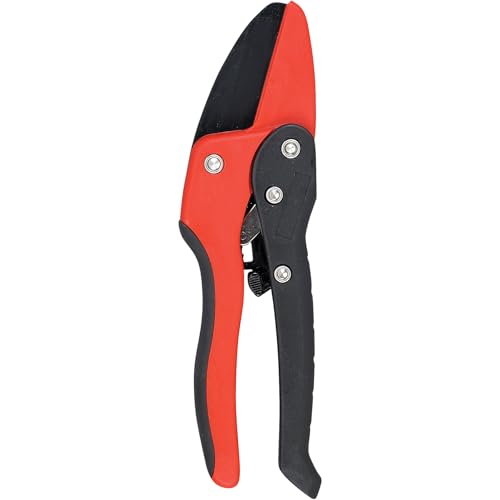
5. Corona RP 3230 Ratchet Pruner: our pick for a weaker grip
Our pick for a weaker grip
Best for: A grip that tires or aches
Corona RP 3230 Ratchet Pruner
- Action: Ratchet
- Cuts up to: 3/4 inch
- Hand: Either hand, all sizes
A ratchet pruner that cuts in stages, up to 3/4 inch, for either hand.
The RP 3230 is Corona's ratchet pruner with a 3/4 inch cutting capacity. Corona lists a "power-multiplying ratchet action for easy cutting", a non-stick coated blade, stainless steel rivets, a molded grip it shapes to fit all hand sizes, use in either hand, and a squeeze-to-release lock.
Why it is our pick: Tom's Guide's tester explains that ratchet pruners cut in stages, up to four squeezes for one cut, and calls them ideal for thicker wood or for a gardener who lacks hand strength. Corona's 3/4 inch capacity matches the stem size Iowa State Extension generally gives for hand pruners.
Good to know: Corona describes the RP 3230 by its ratchet action and coated blade. Bob Vila's guide describes ratchet pruners in general as built on the anvil design, a better match for dry, dead branches than for fresh green growth, so keep snips or a bypass pruner for live harvest cuts. Corona lists a lifetime warranty against material and workmanship defects.
6. Felco 31: our pick for dead wood

Our pick for dead wood
Best for: Dead twigs and dry wood
Felco 31
- Blade: Anvil, for dry wood
- Cuts up to: 0.98 inch
- Hand: Large; left or right
An anvil pruner for dry wood up to 0.98 inch, for either hand.
The Felco 31 is an anvil pruner Felco lists for dry wood: a 0.98 inch cutting diameter, a straight blade beveled on both sides, 8.46 inches long and 0.5 pound, sized for a large hand and made for left- or right-handers.
Why it is our pick: Iowa State Extension finds anvil pruners effective on dead branches and less likely to jam than bypass types. Ohio State Extension's blueberry steps include taking out dead twigs along with diseased and broken canes. Felco pitches the 31 at hard or dead wood.
Good to know: Iowa State adds that an anvil can't make as close a cut and is more likely to crush the stem, so keep the 31 for dead wood. Felco lists it as made in Switzerland, with a lifetime warranty on all forged aluminum parts.
How we chose these
We started from the cuts a vegetable and fruit garden needs, from harvest clips to berry canes and dead wood, and gave each pick one job. We compared the feeder draft's six models with the results of two Amazon catalog searches, then read each pick's maker page: Felco's for the 2, 14 and 31, and Corona's for the BP 3160, FS 3214D and RP 3230. The job facts come from extension pages at the University of Maryland, Iowa State, the University of Minnesota, Colorado State, the University of Illinois, UW-Madison and Ohio State. We also read three independent roundups whose reviewers used the tools, Bob Vila, Tom's Guide and Reviewed, and name them wherever a finding is theirs. The Creators API read of October 29, 2026 found every pick in stock with a new buy-box offer, and the picks span two brands, Felco and Corona. We do not run growing trials or show star ratings.
Also considered
Corona ClassicCUT BP 3180D. The 1 inch size of pick 2, sized by Corona for medium to large hands. Reviewed's tester found this 1 inch model harder to close than the Felco and the Fiskars; the Tom's Guide notes above are on the 3/4 inch size, so we picked that.
Fiskars Micro-Tip Pruning Snip. Bob Vila's reviewers found it excelled at precise cuts in soft green growth and also handled fine woody stems such as mature sage, oregano and thyme. We could not save a Fiskars product page for its specs, so Corona's snips hold the slot.
Felco 9. Bob Vila's left-handed choice, which its reviewers describe as a mirror image of the Felco 2 with a more comfortable grip. Here, the Corona snips, the RP 3230 and the Felco 31 are listed for either hand.
Bypass or anvil: which pruners does a food garden need?
A bypass pruner, for nearly every cut. It works like scissors, a curved blade passing a broader one (Maryland Extension), while an anvil pruner closes a straight blade onto a flat block. Maryland judges bypass pruners superior because they reduce tearing and crushing, and Colorado State Extension also favors the scissor type and finds the anvil more prone to tearing and mashing tissue.
The anvil still earns a place for dead wood, where Iowa State finds it effective and less likely to jam. Reviewed's tester agrees that anvils handle hard, dead wood but tend to mash greener, more elastic stems. In a food garden, most of the cuts listed below are on live wood; dead twigs and dry stalks are the anvil's share.
How thick a stem can hand pruners cut?
Four of the five extension pages in the table below put a hand pruner's limit between 3/4 inch and 1 inch; Colorado State sets it lower: up to 1/4 to 1/2 inch, depending on how hard the wood is. The five pruners we picked list capacities from 0.71 inch (Felco 14) to 0.98 inch (Felco 2 and Felco 31).
| Extension page | Hand pruners | Loppers | Saw |
|---|---|---|---|
| Iowa State, Guide to Pruning Equipment | Generally up to 3/4 inch | 3/4 inch to 1 1/2 inches | Over 1 3/4 inches |
| Minnesota, Pruning trees and shrubs | Up to 3/4 inch | Up to 1 1/2 inches | Over 1 inch; tri-cut saws up to 4 inches |
| Minnesota, Caring for winter pruning tools | Up to 3/4 to 1 inch | Not given | Not given |
| Maryland, Pruning Tools | Up to 1 inch | Up to 3 inches | Not given |
| Colorado State, Pruning Cuts | Up to 1/4 to 1/2 inch, by wood hardness | Generally up to 2 inches | Over 1/2 inch |
Iowa State says pushing hand pruners past 3/4 inch often leaves torn, jagged cuts and may damage the pruners. And a listed capacity is not a promise: in Reviewed's trial, none of the 10 pruners cut cleanly through a 1 inch hardwood dowel, and the Fiskars got through only after repeated attempts. For blueberries, Ohio State Extension uses hand pruners on one-year-old wood and suggests a lopper or saw once wood reaches two or three years.
Which garden cuts need pruners, and when?
A food garden has two cutting seasons: harvest, and dormant pruning before spring growth. Minnesota Extension names late winter to early spring, the late dormant season, as the time for most pruning, and warns that cuts made in autumn or early winter are more likely to dry out and die back. So in October, its timing points to finishing harvest cuts and leaving most pruning until late winter.
- Peppers and eggplant, summer: Minnesota clips eggplants at mature size, and most peppers, with sharp shears. See growing peppers, growing eggplant and the nightshade family.
- Okra, summer: Illinois Extension cuts pods with pruning shears, wearing gloves and long sleeves, since the plants carry short hairs that may irritate skin. More in our okra guide.
- Tomato suckers, summer: UW-Madison Extension pinches small suckers off between thumb and index finger, or uses scissors or hand pruners, and on indeterminate plants leaves the one sucker below the lowest flower or fruit cluster. See pruning tomatoes and growing tomatoes.
- Basil and soft herbs, summer: new growth from a basil cut should show within a week, Minnesota says. More in our basil guide.
- Raspberries, after harvest and before spring growth: for summer-bearing red raspberries, Minnesota cuts every cane that fruited to the ground after the last harvest; for a fall crop only, it cuts every cane down to the base in spring, before new growth starts.
- Blueberries, early spring: after the first year, Minnesota prunes the bushes each early spring before growth starts. Ohio State takes out diseased and broken canes, dead twigs and canes seven years old or older.
- Apple trees, late winter: Minnesota prunes apples from February to early April, because spring or summer pruning raises the chance that fireblight, a bacterial disease, infects and spreads.
What to look for in pruning shears
- Blade type: bypass for live stems and harvest cuts, anvil for dead wood, as Maryland and Iowa State Extension advise.
- Cutting capacity: a listed capacity near 3/4 to 1 inch matches the hand-pruner range in four of the five extension pages above; anything thicker belongs to loppers or a saw.
- Hand size and hand: Felco sorts hands by length, measured flat from the base to the end of the middle finger: small under 6 7/8 inches, medium 6 7/8 to 7 7/8 inches, large 7 7/8 inches and up. Check whether a model is made for right hands, left hands or either.
- An edge you can keep: Maryland Extension keeps cutting edges sharp with a file, diamond sharpener or whetstone. A resharpenable blade (Corona) or replaceable parts (Felco) keeps a pair working.
- Easy cleaning: Minnesota Extension washes pruners with soap and water to get the sap off, then oils the blades, which can help prevent rust. A sap groove (BP 3160) or non-stick blade (RP 3230) eases the job, Corona says.
Sources
- Felco, "Felco 2 Pruner"
- Felco, "Felco 14 Pruner"
- Felco, "Felco 31 Pruner"
- Corona, "ClassicCUT Bypass Pruner, 3/4 in. Cut Capacity" (BP 3160)
- Corona, "ClassicCUT Bypass Pruner, 1 in. Cut Capacity" (BP 3180D)
- Corona, "ComfortGEL Micro Snips" (FS 3214D)
- Corona, "Ratchet Pruner, 3/4 in. Cut Capacity" (RP 3230)
- University of Maryland Extension, "Pruning Tools"
- Iowa State University Extension, "Guide to Pruning Equipment"
- University of Minnesota Extension, "Pruning trees and shrubs"
- University of Minnesota Extension, "Caring for winter pruning tools"
- Colorado State University Extension, "Pruning Cuts"
- University of Illinois Extension, "Readying your garden tools"
- UW-Madison Extension, "Tomato Pruning"
- University of Minnesota Extension, "Growing peppers"
- University of Minnesota Extension, "Growing eggplant"
- University of Minnesota Extension, "Growing basil"
- University of Illinois Extension, "Okra"
- University of Minnesota Extension, "Growing raspberries in the home garden"
- University of Minnesota Extension, "Growing blueberries in the home garden"
- Ohio State University Extension, "Pruning Highbush Blueberries"
- Bob Vila, pruning shears roundup (2026)
- Tom's Guide, pruning shears roundup (2025)
- Reviewed, pruning shears roundup (2023)
Related guides
- How to prune tomatoes
- How to grow peppers
- How to grow okra
- How to grow basil
- How to grow zinnias, cut for the vase with clean pruners or scissors
- Flowers from seed, with a plan for a cut flower garden
- Compost bins buying guide
Frequently asked questions
What is the difference between bypass and anvil pruners?
A bypass pruner cuts like scissors, with a curved blade sliding past a broader one, while an anvil pruner presses a straight blade onto a flat block. Maryland Extension calls bypass pruners superior because they tear and crush less tissue. Iowa State Extension keeps anvil pruners for dead branches, where they are less likely to jam.
How thick a branch can pruning shears cut?
Most hand pruners are meant for stems up to about 3/4 to 1 inch thick. Iowa State Extension generally gives 3/4 inch, Maryland Extension 1 inch, and Colorado State Extension up to 1/4 to 1/2 inch, depending on how hard the wood is. Past that, Iowa State moves branches of 3/4 inch to 1 1/2 inches to loppers.
Are pruning shears and hand pruners the same tool?
Usually, yes: Iowa State and Minnesota Extension both use "pruning shears" for the one-hand pruner, and Iowa State writes hand pruners or pruning shears as two names for one tool, generally used on branches up to 3/4 inch. Maryland Extension instead gives the name to hedge clippers, for hedges only.
Should you cut or pull peppers off the plant?
Cut most of them. University of Minnesota Extension says some peppers separate easily, but harvests most by clipping the fruit's stem with sharp shears, and clips eggplants the same way. Illinois Extension gives the same advice for okra: pruning shears make clean cuts that leave the rest of the plant unharmed.
How do you disinfect pruning shears between plants?
Wipe or dip the blades in rubbing alcohol. UW-Madison Extension treats pruners for at least 30 seconds before pruning and between each plant. Maryland Extension also allows bleach mixed one part to nine parts water, rinsed off afterward, but Illinois Extension advises against bleach on pruners because it can be very corrosive to metal.
How do you sharpen bypass pruners?
Sharpen just the beveled edge of the cutting blade. Colorado State Extension says never to sharpen the anvil side of a bypass blade. Maryland Extension uses a file, diamond sharpener or whetstone, and Minnesota Extension follows the blade's natural bevel and strokes in one direction, over and over, rather than back and forth.
Can you prune fruit trees and berry bushes in the fall?
It is better to wait for late winter or early spring. University of Minnesota Extension says cuts made in autumn or early winter are more likely to dry out and die back, and prunes apples from February to early April and blueberries in early spring. Minnesota does cut summer raspberry canes that already fruited right after harvest.
What you'll need for pruning shears
Picks on Amazon
- Felco 2 Check price on Amazon
- Corona ClassicCUT BP 3160 Check price on Amazon
- Corona FS 3214D Micro Snips Check price on Amazon
- Felco 14 Check price on Amazon