
Best Seed Starting Trays (2026): 5 Picks
Our pick for sowing most transplants is the Bootstrap Farmer 32 Cell Tray: each cell is 2 inches square, or 4 square inches, inside the cell sizes University of Maryland Extension gives for greens and for broccoli and cabbage. For a solid tray and dome, the Bootstrap Farmer 1020 Trays with Humidity Domes; for potting up tomatoes and peppers, CowPots 4 inch square pots; for squash, cucumbers and melons, CowPots 3 inch round pots; for a kit that waters itself, Burpee's XL self-watering system with 32 cells.
On this page
As an Amazon Associate we earn from qualifying purchases.
Our top picks

Our pick for sowing most transplants
1. Bootstrap Farmer 32 Cell Tray
Best for: Greens, broccoli and cabbage, one per cell

Our pick for a solid tray and humidity dome
2. Bootstrap Farmer 1020 Trays with Humidity Domes
Best for: Bottom watering and germination

Our pick for potting up tomatoes and peppers
3. CowPots 4 Inch Square Plantable Pots
Best for: Tomatoes, peppers and eggplant moving up
Our pick for sowing most transplants is the Bootstrap Farmer 32 Cell Tray: each cell is 2 inches square, or 4 square inches, which sits inside the cell sizes University of Maryland Extension gives for greens and for broccoli and cabbage. For a solid tray and dome to hold it, our pick is the Bootstrap Farmer 1020 Trays with Humidity Domes. For potting up tomatoes and peppers, CowPots 4 inch square pots; for squash, cucumbers and melons, CowPots 3 inch round pots; for a kit that waters itself, Burpee's XL self-watering system with 32 cells.
Below: each pick's job, Maryland's cell sizes worked out in inches, when the dome comes off and how to water from below, with Minnesota and Maryland Extension compared where they differ.
Start here: which seed starting tray for your crops
- Lettuce, kale, broccoli and cabbage, one seedling per cell: Bootstrap Farmer 32 Cell Tray (pick 1).
- A solid tray to water from below, and a dome for germination: Bootstrap Farmer 1020 Trays with Humidity Domes (pick 2).
- Tomatoes, peppers and eggplant ready to move up: CowPots 4 Inch Square Plantable Pots (pick 3).
- Squash, cucumbers and melons, sown in the pot they go out in: CowPots 3 Inch Round Plantable Pots (pick 4).
- Everything in one box, watered from below while you are away: Burpee XL Self-Watering Growing System, 32 Cells (pick 5).
The fork is the crop. Maryland sizes cells by crop group, and Minnesota moves seedlings that outgrow their cells into containers 1 to 2 inches wider, so plan the tray around what you will sow. Our starting seeds indoors guide covers timing, mix, light and hardening off.
The picks, by job
One seed starting job per pick. Specs are the makers' own figures; a cell's square inches are our arithmetic on them.
1. Bootstrap Farmer 32 Cell Tray: our pick for sowing most transplants
Our pick for sowing most transplants
Best for: Greens, broccoli and cabbage, one per cell
Bootstrap Farmer 32 Cell Tray
- Cells: 32, each 2 inches square
- Cell depth: 2 inches
- Warranty: 1 year against breakage or warping
A reusable 32 cell insert whose 2 inch square cells fit Maryland's sizes for greens and the cabbage family.
A reusable plastic insert of 32 cells for a standard 1020 flat. Bootstrap Farmer lists each cell at 2 inches square and 2 inches deep. The cells taper slightly toward the bottom, where drainage holes let roots grow on through if you want them to, yet stay small enough to hold moistened vermiculite. The same tray also holds Bootstrap Farmer's 2.5 inch pots.
Why it is our pick: The cell size fits the crops most people start first. A 2 inch cell gives 4 square inches, inside Maryland's 3 to 6 for lettuce, kale and other greens, and at the bottom of its 4 to 9 for squash, cucumber, broccoli and cabbage. Minnesota recommends divided containers with a single seedling in each, rather than many seeds sown in one larger container, because roots that share a container grow together and are likely to be hurt when you transplant. Nathan Heinrich, a horticulturist NBC Select interviewed, adds that open trays without cells are quicker to sow but leave more work dividing seedlings at transplant time. Bootstrap Farmer builds the tray to be reused season after season and backs it with a 1 year warranty against breakage or warping.
Good to know: The tray has drainage holes, so it needs a solid tray under it; Bootstrap Farmer designed it to sit in a 1020 tray without holes for bottom watering (pick 2 is one). Maryland's size for tomato, eggplant and pepper is 9 to 16 square inches, so those seedlings move up from here (pick 3), which Maryland says often happens 2 to 3 weeks after they germinate.
2. Bootstrap Farmer 1020 Trays with Humidity Domes: our pick for a solid tray and humidity dome
Our pick for a solid tray and humidity dome
Best for: Bottom watering and germination
Bootstrap Farmer 1020 Trays with Humidity Domes
- Dome vents: 2, adjustable
- Tray wall: 1.8 to 2.0 mm
- Tray warranty: 2 years
A heavy 1020 tray and a vented dome that rests on its rim, the half of the setup a cell tray lacks.
Heavy plastic 1020 trays with matching domes. Bootstrap Farmer makes the tray in the USA from BPA-free number 5 polypropylene, 1.8 to 2.0 mm thick, with outer dimensions of 21.1 by 11.0 inches and 2.5 inches deep. The dome is made in the USA from the same number 5 polypropylene, rises to 5.4 inches at most, has 2 adjustable humidity vents and an easy-grip handle, and rests on the tray's rim rather than sealing to it.
Why it is our pick: A cell tray needs this other half of the setup. Maryland says a tray without holes works like a saucer under cells that drain, and that a clear cover such as a seed starting dome raises humidity and temperature for germination. Bootstrap Farmer says its frosted dome spreads light evenly over seedlings and fits plug trays and deep 1020 trays, its own among them. It lists a 2 year warranty on the tray.
Good to know: Bootstrap Farmer sells the 1020 tray with or without drainage holes; for bottom watering you want the solid one, so check which the listing ships. Maryland warns that undrained flats are easy to overwater. Bootstrap Farmer's warranty on the dome does not cover one left bare in the sun for long periods, since sunlight degrades all plastic.
3. CowPots 4 Inch Square Plantable Pots: our pick for potting up tomatoes and peppers
Our pick for potting up tomatoes and peppers
Best for: Tomatoes, peppers and eggplant moving up
CowPots 4 Inch Square Plantable Pots
- Top: 4 inches square
- Height: 3 3/4 inches
- Volume: 450 mL
A 4 inch square manure pot, 16 square inches, that goes into the garden with the seedling.
Square pots made from composted cow manure that you plant whole. CowPots lists the #4 Square at 4 by 2 1/2 by 3 3/4 inches, with a volume of 450 mL, about 1/2 quart. It recommends this size for seedlings that need more days indoors before transplanting, naming eggplant, peppers and tomatoes, and for stepping seedlings up into a larger container.
Why it is our pick: The move-up step calls for this size. In our reading, the first of CowPots' figures is the top, 4 inches square, which gives 16 square inches, the top of Maryland's 9 to 16 for tomatoes, peppers and eggplant, and it is 2 inches wider than a 2 inch cell, the top of Minnesota's 1 to 2 inch range. For that move, Minnesota suggests bigger peat pots, or plastic cups with a few holes punched through the bottom. CowPots says roots grow through the pot wall, so the seedling goes into the garden pot and all without its roots being disturbed.
Good to know: The pots are fragile when wet, and CowPots warns that a freshly watered pot will tear if you lift it by the lip; a tray under them can make moving them easier. CowPots says that once planted, the #4 Square lasts up to 3 months in greenhouse conditions. Sold in packs of 12 pots, they are single-use: you plant the pot.
4. CowPots 3 Inch Round Plantable Pots: our pick for squash, cucumbers and melons

Our pick for squash, cucumbers and melons
Best for: Squash, cucumbers and melons, planted pot and all
CowPots 3 Inch Round Plantable Pots
- Top: 3 1/4 inches round
- Height: 3 3/8 inches
- Volume: 275 mL
A 3 1/4 inch round pot you plant whole, sized inside Maryland's range for squash and cucumber.
Round manure pots for seedlings that go into the garden quickly. CowPots lists the #3 Round at 3 1/4 by 2 1/4 by 3 3/8 inches and 275 mL, with slightly more volume than its #3 square, and says 18 fit loosely in a 1020 tray. CowPots says round pots let more air move between them, which helps the pot walls last.
Why it is our pick: Pots of fiber or paper, which break down in the soil, suit seedlings that transplant poorly, Minnesota says, and it names cucumbers and squash. Maryland grows cucumbers, squash and melons as transplants for 2 to 4 weeks and says they need no potting up, so the first container is the last one. A 3 1/4 inch round top gives about 8.3 square inches, inside Maryland's 4 to 9 for squash and cucumber. Bob Vila's reviewer filled a set of these 3 inch CowPots with soil and kept it moist for a full month, and reports the pots held up without breaking apart.
Good to know: The same reviewer adds that the pots, not being plastic, can dry out faster, and noticed a slight manure smell when wet; CowPots describes the smell as earthy. CowPots also says manure holds moisture, so let each pot dry and harden between waterings. Minnesota and CowPots differ at planting time: Minnesota, which names cow-dung pots alongside peat and newspaper pots, says to cut the collar back to soil level and tear holes in the bottom, while CowPots says to bury the whole pot and not break it up.
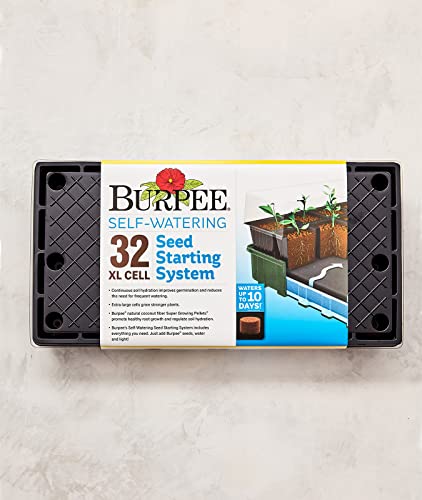
5. Burpee XL Self-Watering Growing System, 32 Cells: our pick for a kit that waters itself
Our pick for a kit that waters itself
Best for: Days you cannot water
Burpee XL Self-Watering Growing System, 32 Cells
- Cells: 32, each 2.25 by 2.25 by 2 inches
- Size: 10 by 20 inches
- Watering: Mat; a fill may last up to 10 days
A complete 10 by 20 inch kit whose mat draws water up to 32 cells; Burpee says a filled reservoir may last up to 10 days.
A complete 10 by 20 inch kit: two 16-cell planting trays, two plant stands, a watering tray, a self-watering mat, a dome lid and 32 coir pellets. Burpee lists the cells at 2.25 by 2.25 by 2 inches. You set the stands in the watering tray, lay the mat over them with its ends touching the bottom, and set the cell trays on the mat, which draws water up to the cells.
Why it is our pick: The mat waters on the days you cannot. Burpee says a filled reservoir may last up to 10 days, though its instructions still have you check the reservoir every few days. Each 2.25 inch cell gives about 5.1 square inches, inside Maryland's 3 to 6 for greens and 4 to 9 for squash, cucumber, broccoli and cabbage, and the growing medium comes in the box as coir pellets.
Good to know: Burpee recommends the kit for tomatoes, peppers and eggplant; Maryland's 9 to 16 square inches for those crops means they still move up to a larger pot before planting out (pick 3). Burpee's own steps sow two seeds per cell and snip the weaker seedling after a couple of weeks. The coir pellets go in flat side down, with warm water added slowly.
How we chose these
We compared 28 seed starting trays, inserts, pots and kits listed on Amazon or in the makers' own stores, plus one independent tester's list, starting from the job: Maryland's cell size for each crop group and Minnesota's advice on dividers, domes, bottom watering and potting up. A pick had to have its cell or pot size on its maker's page and fit the crop it is picked for, so the common 72-cell trays fell out (see Also considered). Each pick's specs come from its maker: Bootstrap Farmer, CowPots or Burpee. Growing facts come from the University of Minnesota Extension and University of Maryland Extension seed starting guides. Findings attributed to a tester come from Bob Vila's seed starting tray roundup, whose reviewers handled seven trays and kits, among them a set of the 3 inch CowPots; it covered none of our other picks. A Creators API read on October 30, 2026 showed each of the five picks in stock with a new Amazon offer; they span three brands. We do not run growing trials or show star ratings.
Also considered
Bootstrap Farmer 72-Cell Seed Starting Tray. A sturdy reusable tray, but Bootstrap Farmer lists each cell at 1 1/2 inches square, or 2.25 square inches, below the smallest size Maryland gives for any crop.
Burpee 72 Cell Greenhouse Kit. A first kit with a tray, dome and coir pellets, but Burpee lists its cells at 1.5 by 1.5 by 2 inches, the same 2.25 square inches.
Epic Gardening 6-Cell Seed Starting Trays. Small reusable trays that lift out one at a time; Epic says 12 of them in a 1020 tray replicate a classic 72-cell tray, and its page lists no cell size.
Burpee SuperSeed 36 Cell Seed Starting Tray. Silicone cells that pop seedlings out, but Burpee's page gives no cell size, so we could not check it against Maryland's figures.
Jiffy 36 Peat Pellet Greenhouse Kit. Bob Vila's reviewers found its materials flimsy and wrote that its tray and dome may last only a season or two; its dome has no vents, so you lift it by hand to let moisture out.
What size cells do seedlings need?
The crop decides it, and a common cell is smaller than any size Maryland gives. Bob Vila's guide calls 1.5 by 1.5 inches the standard cell size. Maryland's guide sizes cells by crop group: 3 to 6 square inches for greens such as lettuce, beets, spinach and kale; 4 to 9 for squash, cucumber, broccoli and cabbage; and 9 to 16 for tomato, eggplant and pepper. As squares, that is roughly 1.7 to 2.4 inches, 2 to 3 inches and 3 to 4 inches a side. Here is how the containers on this page compare:
| Container | Maker's top size | Square inches (computed) | Maryland group it fits |
|---|---|---|---|
| Bootstrap Farmer 72-cell tray (not picked) | 1 1/2 inches square | 2.25 | None: below 3 |
| Bootstrap Farmer 32 cell tray (pick 1) | 2 inches square | 4 | Greens (3 to 6); squash, cucumber, broccoli, cabbage (4 to 9) |
| Burpee XL self-watering cells (pick 5) | 2.25 by 2.25 inches | 5.1 | Greens (3 to 6); squash, cucumber, broccoli, cabbage (4 to 9) |
| CowPots #3 Round (pick 4) | 3 1/4 inches across, round | 8.3 | Squash, cucumber, broccoli, cabbage (4 to 9) |
| CowPots #4 Square (pick 3) | 4 inches square (top, our reading) | 16 | Tomato, eggplant, pepper (9 to 16) |
Two readings follow. First, the small 72-cell tray is not wrong for every plan: Maryland says tomato, pepper and eggplant are often sown one seed per cell and moved into larger containers 2 to 3 weeks after they germinate, and Minnesota moves any seedling that outgrows its cell pack into a container 1 to 2 inches wider. But a 1 1/2 inch cell sits below every size Maryland lists, so on our reading anything grown to transplant size in one needs that move. Second, some crops skip the move: Maryland grows cucumber, squash and melons for 2 to 4 weeks and says they need no potting up, so size their first container for the whole stay. Minnesota makes one exception to one seedling per cell: onions and leeks can start together in one larger flat and go out while still small.
Depth counts too. Maryland says almost any clean container works for seed starting if it drains well and is 2 inches deep or more, and every pick here meets that: 2 inches for the 32 cell tray and the Burpee cells, 3 3/8 and 3 3/4 inches for the two CowPots.
Do you need a humidity dome?
For germination, yes; after that, no, though the sources differ on when it comes off. Maryland says to cover a sown container with clear plastic, such as a seed starting dome, to raise humidity and temperature, and that the cover should not touch the growing medium. Minnesota says a clear dome lets light in, keeps moisture from escaping and can help hold heat given to the root zone.
The timing is where they part. Maryland's rule is to remove the cover once sprouts show. Minnesota leaves the dome on until the seedlings are tall enough to brush it. Burpee, in its self-watering instructions, lifts the lid once about half the seedlings have come up and moves the tray under lights; our grow lights for seedlings buying guide covers that next step.
Vents help in between. Bootstrap Farmer's dome has 2 adjustable vents. Bob Vila's reviewers point out that the Jiffy kit's dome has none, so you watch the condensation and lift the lid yourself to head off fungal problems such as damping off, and they credit the Park Seed Bio Dome's double vents with better control over humidity and airflow.
How do you water seed trays from below?
Set the cells in a tray without holes, pour a shallow layer of water into the tray and let the mix soak it up through the drain holes. That is Maryland's method, and Minnesota gives the same one. Both warn about the other side: Maryland says undrained flats are easy to overwater, and Minnesota says to drain any water that stays in the tray to keep roots healthy.
The picks handle this differently. Bootstrap Farmer designed its 32 cell tray to sit in a 1020 tray without holes for this job. Burpee's mat does it for you, drawing water from the reservoir to the cells. CowPots can be watered from the top or the bottom, and their walls soak up water when you bottom water; CowPots says that works as long as the outside of the pot dries between waterings, which cuts mold and keeps the pot sturdy. CowPots says the pots darken when wet and lighten when they need water.
Wet mix is the risk to manage. Maryland says the water molds Pythium, Phytophthora and Rhizoctonia bring root rot and damping off, which can kill a whole container of seedlings quickly when the mix stays too wet, so water to keep the mix moist, not wet. Minnesota recommends a commercial seed starting mix, usually peat and vermiculite with no true soil, which it calls sterile, light and free of weed seed, and says bottom heat can help prevent damping off.
What to look for in a seed starting tray
- Cell size for the crop: Maryland's 3 to 6 square inches for greens, 4 to 9 for squash, cucumber, broccoli and cabbage, and 9 to 16 for tomato, eggplant and pepper. A cell's side in inches, squared, gives its square inches.
- Drainage and depth: Minnesota says every seed starting container must have drainage holes, and Maryland wants at least 2 inches of depth.
- Fit: Minnesota says cell flats fit into standard trays, and a standard flat, by Maryland's figure, measures 10 by 20 inches and can hold 10 to 120 plants, depending on cell size. Bootstrap Farmer says its 32 cell tray fits any standard 1020 flat.
- Plastic that lasts: Maryland says plastic cell packs and flats can give several years of reuse with careful handling, though flimsier plastic may tear. Bootstrap Farmer warrants its 32 cell tray for 1 year and its 1020 tray for 2.
- A dome with vents: Bob Vila's reviewers say the unvented Jiffy and GrowEase covers have to be lifted by hand now and then for airflow; Bootstrap Farmer's dome has 2 adjustable vents.
Sources
- "University of Minnesota Extension: Starting seeds indoors"
- "University of Maryland Extension: Starting Vegetable Seeds Indoors"
- "Bootstrap Farmer: Seed Starter Trays, 32 Cell", "1020 Extra Strength Trays", "1020 Extra Strength Humidity Domes" and "72-Cell Seed Starting Trays"
- "CowPots: #4 Square", "#3 Round", "Product Specifications", "How to Use" and "FAQs"
- "Burpee: 32 XL Cell Self-Watering Ultimate Growing System", "How to Use the Burpee Self-Watering Seed Starting System", "72 and 36 Cell Greenhouse Kits" and "36 Cell SuperSeed Seed Starting Tray"
- "Epic Gardening: Epic 6-Cell Seed Starting Trays"
- "Bob Vila: seed starting tray roundup (Debbie Wolfe)"
- "NBC Select: seed starting trays recommended by gardening experts (Cory Fernandez)"
Related guides
- Starting seeds indoors, the full how-to from sowing date to hardening off.
- Grow lights for seedlings buying guide, our pick for each lighting job over the trays.
- Brassicas, the cabbage family, most of it started in cells.
- Cucurbits, the squash family, and how its crops are started.
- Fungus gnats, the small flies that hover over wet seed trays.
Frequently asked questions
What size cells do tomato and pepper seedlings need?
Plan on 9 to 16 square inches by the time they go out, a 3 to 4 inch square. University of Maryland Extension gives that size for tomato, eggplant and pepper, which it says are often sown one seed per cell and moved up to bigger containers 2 to 3 weeks after they sprout.
When do you take the humidity dome off?
Once the seedlings are up, though the sources pick different moments. University of Maryland Extension removes the cover once sprouts show. University of Minnesota Extension waits until seedlings are tall enough to touch the dome, and Burpee lifts its lid once about half the seedlings have come up.
How do you clean seed starting trays to reuse them?
Wash them, soak them in disinfectant, then rinse. University of Minnesota Extension soaks clean used containers for 30 minutes in bleach or another disinfectant mixed to the label's strength for surfaces. After a disease outbreak, Maryland Extension soaks washed containers 1 to 2 minutes in chlorine bleach diluted 1 part to 10 parts water.
Why do seedlings collapse in seed trays?
Damping off is one cause: water molds can kill seedlings in mix kept too wet. University of Maryland Extension names Pythium, Phytophthora and Rhizoctonia and says to keep the mix moist but not wet. University of Minnesota Extension recommends a sterile commercial seed starting mix and says bottom heat can help prevent damping off.
Can you start squash and cucumbers in seed trays?
Yes, in a large cell or a pot you plant whole, sown close to planting out. University of Maryland Extension grows them 2 to 4 weeks as transplants with no potting up. University of Minnesota Extension says pots that break down in garden soil suit them, and CowPots says not to start cucurbits more than 3 weeks ahead.
Can onions and leeks share one seed tray?
Yes, they are the exception to one seedling per cell. University of Minnesota Extension says onions and leeks can share one larger flat and be planted out while still small, and the seedlings take no harm from it. For most other crops it recommends divided containers, so tangled roots are not torn at transplanting.
What you'll need for seed starting trays
Picks on Amazon
- Bootstrap Farmer 32 Cell Tray Check price on Amazon
- Bootstrap Farmer 1020 Trays with Humidity Domes Check price on Amazon
- CowPots 4 Inch Square Plantable Pots Check price on Amazon
- CowPots 3 Inch Round Plantable Pots Check price on Amazon