
How to Grow Corn: Sweet Corn from Planting to Harvest
Sow sweet corn after frost once the soil is warm: close to 60 F for good germination, at least 60 to 65 F for supersweet types. Plant 1 inch deep in a block of at least four rows, and pick when the silks are brown and dry and the kernels milky, usually 17 to 24 days after silking.
Sources: University of Minnesota Extension, University of Maryland Extension, Clemson Cooperative Extension, Utah State University Extension and 5 more. See the sources we used. How we source our guides
On this page
As an Amazon Associate we earn from qualifying purchases.
Sow sweet corn straight into the garden after your last frost, once the soil has warmed: seed germinates well when the soil is close to 60 F, and supersweet types need at least 60 to 65 F. Plant it 1 inch deep, 7 to 12 inches apart, in a block at least four rows wide instead of one long row, so the wind-blown pollen reaches every ear. Pick when the silks are drying and turning brown, usually 17 to 24 days after the silks first show.
The growing advice below comes from seven university extension services; each product spec is from its maker's page, and the Sources list at the end names them all. They often differ on soil temperature, spacing and isolation; where they do, you get the range. One note on names: the houseplant called corn plant is Dracaena fragrans, a different plant, which the ASPCA lists as toxic to dogs and cats. This guide is about garden corn, Zea mays.
| When to plant | Once frost danger has passed, in soil warm enough for the type you grow |
|---|---|
| Soil temperature | At least 50 to 60 F (50 F measured 4 inches deep); germinates well close to 60 F; at least 60 to 65 F for extra-sweet varieties |
| Depth | 1 inch; in light, sandy soil it can be 2 inches |
| Spacing | 7 to 12 inches between plants, 24 to 36 inches between rows |
| Layout | A block of at least three rows, preferably four |
| Water | At least 1 inch a week; most critical at tasseling, silking and ear formation |
| Days to harvest | 60 to 100 days from planting, by variety |
| Pick when | Silks dry and brown, husks green, kernels milky |
Sweet corn types: su, se and sh2
Read the seed packet first. Its code letters name the genes that make a variety sweet, and the type decides how warm the soil must be, how long the ears stay sweet and which other corn to keep it from. There are five main types; the three below are the building blocks, and synergistic and augmented supersweet types combine their genes.
| Type | Sugar | Soil for planting | Sweetness after picking |
|---|---|---|---|
| Standard sugary (su) | 8 to 18 percent, generally 10 to 15 percent at harvest | Germinates well at 55 to 60 F, and better than se or sh2 in cool soil | Only 1 or 2 days of high quality: pick the day you will eat them |
| Sugary enhanced (se) | 30 to 35 percent | Germinates well at 55 to 60 F | Keeps 1 to 2 days longer than su |
| Supersweet or shrunken-2 (sh2) | 40 to 50 percent, two to three times su | At least 60 to 65 F | Can keep up to a week in the refrigerator, with a firmer, crunchy texture |
Supersweet seed is harder to start in cool soil: it is slow to come up in cold, wet spring soil, and the small, light kernels can take up to double the water of other seed before sprouting. Standard types lose their sugar quickly instead; su ears left out of the refrigerator may lose 50 percent of their sugar within 12 hours of picking.
When to plant corn
Corn is a warm-season crop, and soil temperature sets the planting date. It grows well at 60 to 80 F and germinates poorly in cold soil, and sowing into wet early-spring soil promotes seed rot. Wait until frost danger has passed, then go by the soil:
- The minimum: 50 to 60 F. The low end is measured at the 4-inch depth.
- Above 55 F: this reduces most seedling rots.
- Close to 60 F: seed germinates well here, so check with a soil thermometer.
- 60 to 65 F: wait for this with extra-sweet varieties; untreated seed needs at least 65 F.
In central Iowa that works out to a sequence by type: standard su corn can go in during late April, se and synergistic types a week later, and supersweet and augmented supersweet types, in general the least tolerant of cold soil, around mid-May.
For an earlier crop, seed may be sown 3 to 4 weeks early under clear plastic tunnels, and sprouting seed before sowing into cool spring soil may help prevent rot. Our frost dates page gives your average last frost; check the soil as well.
How to plant sweet corn in blocks
Corn is pollinated by the wind. Pollen drops from the tassels topping each plant onto the silks of the ears below, and in a single row much of it blows away, leaving ears with blank patches where kernels never formed. So plant a block: at least four rows side by side, or four or more short rows.
Sow about 1 inch deep, or as deep as 2 inches in light, sandy soil. Keep supersweet seed no deeper than three-fourths to 1 inch, and keep the seedbed moist until shoots appear. Space plants 7 to 12 inches apart in rows 24 to 36 inches apart. Early, small varieties go closer, at 8 to 9 inches in rows 30 inches apart; medium to large ones need 10 to 12 inches, in rows 36 inches apart.
When thinning, snip extra seedlings off rather than pulling them, since corn roots take poorly to disturbance. Sow only fresh seed: old seed will likely come up poorly and unevenly. Test a leftover packet first with the germination test in how long seeds last.
At 5 to 8 feet tall, corn belongs where it will not shade other crops, in full sun: at least 6 hours, and 8 to 10 is better.
Keeping corn types apart
Most kinds of corn cross-pollinate readily, and a cross can spoil an ear. A cross between a shrunken (sh2) type and any other gives starchy, tough kernels; se and sh2 corn crossed with other types lose their extra sweetness; and popcorn pollen makes sweet corn tough and starchy.
Keep supersweet and augmented supersweet types away from standard, sugary enhanced and synergistic ones. Standard and sugar enhanced types are where the advice splits: some extension services also isolate se cultivars from standard and synergistic ones, while others say standard and sugar enhanced cultivars need no isolating.
- By distance: 250 feet to 400 yards between plantings, or 300 feet from the nearest cornfield.
- By timing: at least 12 to 14 days apart in silking or tasseling, two weeks apart in planting time or days to maturity, or a month apart in maturity dates.
Few home gardens have room for those distances. Plant one variety earlier than another, pick varieties that mature at different times, or plant a single type of sweet corn and skip isolation.
Watering sweet corn
While most garden plants stop active growth above 85 F, corn keeps growing in very hot weather, and it can become drought-stressed in a hot, dry spell if you do not water.
- How much: 1 inch of water or more each week, rain included; sandy soil needs watering more often than weekly.
- How deep: soak the soil 6 inches deep, since light sprinklings encourage shallow roots. An inch of water wets sandy soil to 10 inches but heavy clay only to 6, so dig with a trowel to check.
- When it matters most: during tasseling, silking, pollination and ear formation and filling. Drought while the ears develop lowers kernel quality and affects flavor.
- How: water in the morning so leaves dry before dark, and wet the soil rather than the plant, since pollination could suffer otherwise.
Feeding sweet corn
Corn feeds heavily, and nitrogen above all must be ample. Start with a soil test, then side-dress as the plants grow:
- First feeding: when plants are 5 to 18 inches tall, or near knee high (8 to 10 leaves). Band a balanced fertilizer beside each row, or scratch in, for example, half a cup of 46-0-0 per 100 feet of row and water it.
- On sandy soil: split that first feeding into two, at 5 inches and at 10.
- Later, if you feed again: side-dress when the tassels or first silks appear, 6 inches from the plants, or monthly through the growing season.
Do not overdo it. Too much nitrogen can cause lodging, which is plants falling over, and plants fed high levels of nitrogen are the most susceptible to corn smut.
Suckers and plants that fall over
Leave the side shoots, or suckers. There is no need to remove them, and taking them off has in some cases been shown to lower yields. Suckering is common when plants stand too far apart; most suckers bear no usable ears, but removing them does not help, so plant closer next time.
To keep a block standing through summer storms, ring the planting with a strand or two of heavy string.
Planting for a longer harvest
Ears can be picked over a 5 to 7 day period. To spread the harvest:
- Plant early, midseason and late varieties, or 65, 70, 75 and 80 day varieties of the same type at once.
- Or sow the same variety again every 10 to 14 days, or once the last sowing has three to four leaves.
- Know when to stop. The last sowing date depends on where you garden. In Utah, sowings run until early July, and in Iowa July 1 is the last practical date for early cultivars; in South Carolina, the spring planting window closes May 31 in the Piedmont and April 15 on the coast. In July, sow only the quickest-maturing cultivars, since caterpillar pests may be numerous by late summer.
When to harvest sweet corn
Count from the day the first silks appear. Ripe ears usually follow 17 to 24 days later, more quickly in hot weather and more slowly in cool; in an exceptionally warm spell, prime maturity may come in 15 days or less.
Then check the ear. The husk should still be green and the silks brown and dry, and the kernels full size out to the tip. Press a kernel with your thumbnail: clear liquid means not ready, milky juice means ready, and no sap means too late. An overmature ear is tough and doughy, and in hot weather of 85 F and above an ear stays at its prime for only 1 or 2 days, so check often.
To pick, grasp the ear at its base and twist it downward. Pick in the early-morning cool and chill the ears at once, since sweet corn loses sugar fast in heat. The optimum for storage is 32 F at 90 to 95 percent relative humidity. Depending on type, ears may keep their quality from 1 or 2 days (standard su) up to a week (supersweet), and some newer types keep fresh and sweet for 2 to 3 weeks.
For baby corn, pick ears 2 to 4 inches long, which most sweet corn varieties reach within 1 to 3 days of the silks showing.
Corn pests and problems
Disease seldom does serious damage to sweet corn in a home garden. In South Carolina, the corn earworm is its most common insect pest.
| What you see | Likely cause | What to do |
|---|---|---|
| A caterpillar and chewed kernels at the ear tip | Corn earworm; also the European corn borer | Choose cultivars whose husks close tightly over the ear tip; cut the damaged tip off in the kitchen and cook the rest |
| Missing seeds and gaps in the row | Crows and other birds eating seed before it comes up | A floating row cover until the plants emerge |
| Ears eaten as they ripen, often overnight | Raccoons, which prefer corn in the early milk stage | An electric fence, running about 2 weeks before the milk stage |
| Lumpy galls on ears, stalks, leaves or tassels, white or grayish-white when young | Corn smut, a fungus | Cut galls out before they release spores and bury them rather than composting them; most modern hybrids resist it |
| Rusty orange streaks on the leaves | Leaf rust | Grow a rust-resistant variety |
| Beetles eating green silks | Japanese beetles, which can leave ears poorly filled | Often handpicking, which takes diligence |
| Ears with bare tips or missing kernels | Often hot, dry weather at silking, crowding, low fertility or poor pollination | Water in dry weather, keep the spacing, test the soil and plant in blocks |
Earworm timing. In Minnesota, planting around early May with a variety that matures in less than 80 days can avoid problems from earworms and corn borers. Mineral oil dropped onto the ear tip 5 to 7 days after silking stops egg laying there.
Raccoon fences. Run two or three wires about 4 inches apart, the lowest 4 to 6 inches off the ground; a two-wire fence can put the upper one at 12 inches.
Smut. Clear corn debris after harvest, because the smut fungus survives the winter on plant debris in the soil.
Growing popcorn
Popcorn needs three extra steps. Isolate it: popcorn pollinated by field or sweet corn may not pop well, and popcorn pollen gives sweet corn poor eating quality. In a small garden, sow the popcorn first, after the soil warms, and wait three weeks before sowing sweet corn, so the popcorn tassels and silks first. Give it time: most varieties generally need 85 to 120 days to mature fully. And let it dry on the stalk as long as possible.
- Planting: direct seed only, 1 inch deep in heavier soil and up to 2 inches in sand, about 7 to 8 inches apart, in at least four rows 18 to 30 inches apart.
- Harvest: ripe ears have dry husks and hard, plump, shiny kernels.
- Ready to store: the ideal moisture is 13 to 14 percent. Pop 20 kernels once a week; when most of the sample pops crisp and fluffy, shell the crop and keep it in airtight containers.
Corn seed and supplies
Choose seed by type (table above), and check the soil with a thermometer before sowing; all four picks are on Amazon.

Our pick for a standard (su) corn
Best for: White ears
Park Seed Silver Queen Sweet Corn Seeds
- Type: Standard sugary (su)
- Soil: At least 60 F
A white standard (su) variety that extension services recommend.

Our pick for a sugary enhanced (se) corn
Best for: Yellow ears
Park Seed Bodacious Hybrid Sweet Corn Seeds
- Type: Sugary enhanced (se)
- Days: 75
A yellow sugary enhanced (se) variety on an extension recommended list.

Our pick for popcorn
Best for: Popping, or fall display
Sow Right Seeds Strawberry Popcorn
- Kernels: Dark red
A popcorn variety on an extension recommended list.
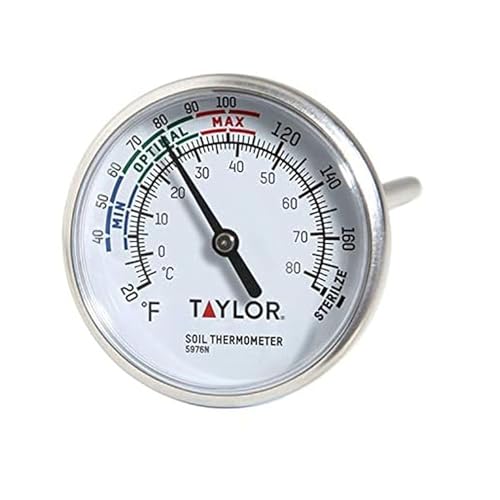
Our pick for checking soil warmth
Best for: Timing the first sowing
Taylor Soil Temperature Thermometer
- Range: 20 to 180 F
A stainless steel dial thermometer for checking soil warmth before sowing.
Taylor's dial thermometer reads 20 to 180 F.
What you'll need for corn
Picks on Amazon
- Park Seed Silver Queen Sweet Corn Seeds Check price on Amazon
- Park Seed Bodacious Hybrid Sweet Corn Seeds Check price on Amazon
- Sow Right Seeds Strawberry Popcorn Check price on Amazon
- Taylor Soil Temperature Thermometer Check price on Amazon
Sources we used
Each sweet corn and popcorn figure in this guide rests on one of these pages; we kept a copy of every page in October 2026, the month we read them.
- "University of Minnesota Extension: Growing sweet corn in home gardens" (reviewed 2026) and "Growing popcorn in home gardens"
- "University of Maryland Extension: Growing Sweet Corn in a Home Garden" (2026) and "Corn earworm or tomato fruitworm" (2023)
- "Clemson Cooperative Extension, HGIC 1308: Sweet Corn" (2023) and "HGIC 2204: Sweet Corn Diseases" (2021)
- "Utah State University Extension: How to Grow Sweet Corn in Your Garden" (2020) and "Popcorn in the Garden"
- "Iowa State University Extension: Growing Sweet Corn in the Home Garden"
- "Penn State Extension: Sweet Corn Production", written for commercial growers
- "NC State Extension, Plant Toolbox: Zea mays"
- Maker pages: Park Seed Silver Queen and Bodacious, Sow Right and Taylor
- "ASPCA Animal Poison Control: plant list for dogs" and for cats, for the corn plant houseplant
Related guides
- How to grow beans, another warm-soil crop to sow after frost.
- Squash and pumpkins, the third of the three sisters.
- Companion planting chart: the three sisters of corn, pole beans and squash, and what the evidence says.
- Protecting plants from frost: row covers and timing when a late chill threatens early-sown corn.
- How long do seeds last?, with a germination test for older seed.
Frequently asked questions
When should you plant sweet corn?
Once frost danger has passed and the soil is warm: at least 50 to 60 F, and at least 60 to 65 F for extra-sweet varieties, with seed germinating well close to 60 F. In central Iowa, su corn goes in during late April and supersweet around mid-May.
How far apart do you plant corn?
Sow seeds about 1 inch deep, 7 to 12 inches between plants, with 24 to 36 inches from row to row. Plant a block of at least three or four rows, not one long row, for good pollination.
How long does sweet corn take to grow?
Anywhere from 60 to 100 days, sowing to picking, by variety. Cultivars count as early under 70 days, midseason at 70 to 84 and late over 84.
How do you know when sweet corn is ready to pick?
The silks are brown and dry, the husks are still green and the kernels give a milky juice when pressed with a thumbnail. That usually comes 17 to 24 days after silking starts, and sooner in hot weather.
Can you plant different types of sweet corn together?
Sometimes. Supersweet (sh2) corn crossed with other types gives starchy, tough kernels, and eating quality may suffer when types tassel together, so keep sh2 apart. For standard and sugar enhanced types the advice splits: some sources say they need no isolating, while others keep se away from standard corn. Isolate by 250 feet to 400 yards, or by 12 to 14 days of silking or tasseling time.
Should you remove suckers from corn?
No. There is no need to remove them, and removing them has in some cases been shown to lower yields.
How long does popcorn take to grow?
Most popcorn varieties generally need 85 to 120 days to mature fully. Plant it first, once the soil is warm, and wait three weeks before sowing sweet corn so the two do not cross. Let the ears dry on the stalk as long as possible.